General situation of Japan

[Name] Japan.

[Area] The land area is about 378,000 square kilometers, including Hokkaido, Honshu, Shikoku and Kyushu and more than 6,800 other small islands.

[Population] About 123.8 million (August 2025). The main ethnic group is Yamato, and there are about 13,000 Ainu people in Hokkaido. Common Japanese. The main religions are Shinto and Buddhism.

【首 都】 东京(Tokyo)。人口约1410万(2025年8月)。

【国家象征】 天皇德仁(Naruhito),2019年5月1日即位,年号“令和”。

【重要节日】 天皇生日:2月23日。建国纪念日:2月11日(系按阳历推算出的公元前7世纪日本第一代天皇神武天皇元年的元旦)。

【简 况】 位于太平洋西岸,是一个由东北向西南延伸的弧形岛国。西隔东海、黄海、朝鲜海峡、日本海与中国、朝鲜、韩国、俄罗斯相望。属温带海洋性季风气候,终年温和湿润。6月多梅雨,夏秋季多台风。1月平均气温北部-6°C,南部16°C;7月北部17°C,南部28°C。

日本位于环太平洋火山地震带,地震、火山活动频繁。全球有1/10的火山位于日本,1/5的地震发生在日本。1995年发生的阪神大地震、2004年新澙县中越地震造成重大人员财产损失,引起世界关注。2011年3月11日,日本发生里氏9.0级特大地震,并引发海啸和核电站泄漏事故,被称为“日本战后以来最严重的危机”。2024年1月1日,日本本州岛中部发生里氏6.9级的能登半岛地震,造成重大人员伤亡和财产损失。

Japan was defeated in World War II and declared unconditional surrender on August 15th, 1945. In the early post-war period, the US military occupied Japan alone, and in 1947, it promulgated and implemented a new constitution, which changed from an imperial country to a parliamentary cabinet country with the emperor as the national symbol. After the war, it pursued the line of "emphasizing economy and neglecting armaments" and became the second largest economic country in the West in the late 1960s. Since the mid-1980s, the goal of becoming a political power has been put forward. In the 1990s, the economy fell into a long-term downturn, and it recovered slowly since 2002, with the longest recovery time after the war. Since 2008, the economic recovery has been frustrated by the international financial crisis and the March 11th earthquake. After Shinzo Abe came to power again at the end of 2012, he pushed the "Abenomics" and implemented a series of economic stimulus policies, which boosted the Japanese economy to some extent. Before the COVID-19 epidemic, Japanese stock market rose, export increased and consumption picked up. After kishida fumio came to power, he proposed to build "new capitalism", promote a virtuous circle of economic growth and income distribution, strengthen economic security, and revise the neo-liberal economic line including "Abenomics". Regard revitalizing Japan’s economy as the top priority, focusing on coping with rising prices and depreciation of the yen, raising national income, and promoting economic growth through investment and reform. Diplomatically, Japan adheres to the Japan-US alliance, attaches importance to multilateral diplomacy, and strives to play an important role in international affairs.

[Politics] The legislative, judicial and administrative powers are separated. The emperor is a national symbol and has no right to participate in state affairs. Congress is the highest power and the only legislature, divided into two chambers. The Cabinet is the highest administrative organ and is responsible to the National Assembly. The Prime Minister (also known as the Prime Minister of the Cabinet) is elected by the National Assembly and appointed by the Emperor.

At present, the Liberal Democratic Party and Komeito Party are in power jointly. The ruling party holds a stable majority in both the House of Representatives and the Senate.

[Constitutional Law] The current Constitution of Japan was promulgated and implemented on May 3, 1947. Article 9 of the Constitution stipulates: "Japan will forever give up waging war, threatening to use force or using force as a means to resolve international disputes. To achieve this goal, Japan will not maintain land, sea, air force and other war forces, and will not recognize the country’s right to engage in war." This has become an important guarantee for Japan to take the road of peaceful development after the war, and it is also an important guarantee for Japan as a peaceful country.

The National Assembly consists of the House of Representatives and the Senate, and is the highest authority and the only legislature. The number of members of the House of Representatives is 465, with a term of four years. The Prime Minister has the right to ask the Emperor to dissolve the House of Representatives and hold a general election. The Senate has a fixed number of 248 members, with a term of six years, and half of them are re-elected every three years, and cannot be dissolved halfway. In power, the House of Representatives is superior to the Senate. The usual Congress is held from January to June every year for 150 days. At other times, temporary and special parliaments can be convened as needed. SEKIGUCHI Masakazu, Speaker of the Senate, took office in November 2024. Fukushiro Nukaga, Speaker of the House of Representatives, took office in November 2024.

[Government] The Cabinet is the highest administrative organ and is responsible to the National Assembly. It consists of the Prime Minister of the Cabinet (the Prime Minister) and the ministers in charge of various provincial offices. The Prime Minister of the Cabinet is nominated by the National Assembly and appointed by the Emperor. Other cabinet members are appointed and removed by the Prime Minister of the Cabinet and certified by the Emperor. The main members of the current cabinet are: Prime Minister Shi Pomao, Chief Cabinet Secretary and Minister for Reducing the Burden of Okinawa Base, Lin Fangzheng, Minister for Kidnapping, MURAKAMI Seichirou, Minister of General Affairs, and SUZUKI Keisuke, Minister of Justice. Minister of Finance and Minister in Charge of Extraordinary Affairs (Finance) of Cabinet Office, KATOU Katsunobu, Minister of Deflation Relief, IWAYA Takeshi, Minister of Foreign Affairs, ABE Toshiko, Minister of Education, Culture, Sports, Science and Technology, FUKUOKA Takamaro, KOIZUMI Shinjiro, Minister of Agriculture, Forestry and Fisheries, Minister of Economy, Trade and Industry, Minister of Atomic Energy Economy Victims, Minister of Green Transformation Promotion, Minister of Industrial Competitiveness, Minister of Cabinet Office Extraordinary Responsibility (Atomic Energy Loss Compensation and Waste Furnace Support Agency) MUTOU Youji, Minister of Land, Infrastructure, Transport and Water Cycle Policy, Minister of World Horticultural Exposition Yoko.(NAKAO Hiromasa), Minister of Environment and Minister Extraordinary of Cabinet Office (Atomic Energy Disaster Prevention), ASAO Keichirou, Minister of Defense (Gen Nakatani), Minister of Digitalization and Minister of Administrative Reform, Minister of National Civil Service, Minister of Network Security, TAIRA Masaaki, Minister Extraordinary in Cabinet Office (Regulatory Reform), ITOU Tadahiko, Minister for Rehabilitation and Minister for Comprehensive Accident Regeneration of Fukushima Nuclear Power Plant, Chairman of the National Public Security Bureau and Minister for Strengthening and Strengthening the Territory, Minister for Territorial Issues, Minister Extraordinary in Cabinet Office (Disaster Prevention and Ocean Policy) SAKAI Manabu, Minister in Cabinet Office (children’s policy, countermeasures for declining birthrate, active youth, joint participation of men and women, symbiosis and mutual assistance), minister in charge of active women, minister in charge of symbiotic society (Junko Mihara), minister in charge of economic regeneration and new capitalism, minister in charge of wage increase, minister in charge of start-up, minister in charge of all-generation social security reform, minister in charge of infectious disease crisis management, and minister in charge of disaster prevention department. AKAZAWA Ryousei, Minister Extraordinary in Cabinet Office (Economic and Fiscal Policy), Minister Extraordinary in Economic Security and Minister Extraordinary in Cabinet Office (Cool Japan Strategy, Intellectual Property Strategy, Science and Technology Policy, Cosmic Policy, Economic Security Guarantee)KIUCHI Minoru, Minister Extraordinary of Cabinet Office (Okinawa and Northern Countermeasures, Consumer and Food Safety, Local Creation, Ainu Policy), Minister of New Local Economy and Living Environment Creation, Minister of International Expo ITOU Yoshitaka, Deputy Chief Cabinet Secretary TACHIBANA Keichirou, AOKI Kazuhiko, SATOU Fumitoshi, and IWAO Nobuyuki, Director of Legal Affairs of the Cabinet.

[Administrative Division] It is divided into 1 prefecture (Tokyo), 1 prefecture (Hokkaido: Hokkaido), 2 prefectures (Osaka Prefecture: Osaka Prefecture, Kyoto Prefecture: Kyoto) and 43 counties (provinces), with cities, towns and villages.

[Judiciary] Judicial power belongs to the Supreme Court and its subordinate courts at all levels. Adopt "four levels and three trials". The Supreme Court is the court of final appeal, hearing unconstitutional and other major cases. The High Court is responsible for the second instance, with eight courts nationwide. Each prefecture, prefecture, prefecture and county has a local court (there are four in Hokkaido), which is responsible for the first instance. There are also summary courts and family courts throughout the country, which are responsible for civil and criminal proceedings not exceeding fines. The Chief Justice (President) of the Supreme Court is nominated by the Cabinet, appointed by the Emperor, and 14 judges (judges) are appointed by the Cabinet, and are subject to national voting. Judges of other courts at all levels are nominated by the Supreme Court and appointed by the Cabinet for a term of 10 years and can be re-elected. Judges at all levels shall not be removed without formal impeachment. The current Chief Justice of the Supreme Court, IMASAKI Yukihiko, took office in August 2024.

The procuratorial organs correspond to the four-level courts and are divided into the Supreme Prosecutor’s Office, the Higher Prosecutor’s Office, the Local Prosecutor’s Office and the District Prosecutor’s Office. Prosecutors are divided into procurator-general (attorney-general), second procurator-general, procurator-general (senior procurator-general), procurator-general (local procurator-general says procurator-general is right) and deputy procurator-general. Officials above the procurator-general are appointed by the cabinet. The Minister of Justice has command over the Attorney General. The current chief procurator, UNEMOTO Naomi, took office in July 2024.

[Political parties and groups] After the war, Japan implemented "party politics", and various political parties representing different classes were successively restored or established. At present, the main political parties are: the ruling Liberal Democratic Party and Komeito Party; The opposition Constitutional Democratic Party, National Democratic Party, communist party, Japan Reform Association, Social Democratic Party, etc.

(1) Liberal Democratic Party (LDP): the ruling party, the largest party. In November 1955, it was formed by the merger of the former Liberal Party and the Democratic Party. Since then, it has been in power alone for 38 years. In 1993, he went out of office, and later formed a joint regime with other parties several times. Since April 2000, it has been in power jointly with Komeito Party and Conservative Party. In November 2003, the Liberal Democratic Party absorbed the conservative new party, one of the three former ruling parties, and formed a joint ruling situation with the Komeito Party. In August 2009, the Liberal Democratic Party suffered a crushing defeat in the House of Representatives election and became an opposition party again. In December 2012, he won the House of Representatives election and returned to power. It advocates that we should base ourselves on the concept of democratic politics, maintain the free economic system, amend the constitution, adhere to the security system of Japan and the United States, and strengthen our independent defense forces. In terms of foreign policy, it emphasizes taking the Japan-US alliance as the basic axis and actively expanding the diplomatic layout. Shi Pomao, the current president, SUGA Yoshihide, the vice president, and MORIYAMA Hiroshi, the secretary general.

(2) Komeito Party: the ruling party. It was founded in November 1964, and its mother was Sōka Gakkai, a religious group. In June 1970, the separation of church and state was implemented. In August 1993, he joined the non-self-democratic Coalition regime and went through a split and combination. In April 2000, the Komeito Party formed a coalition with the Liberal Democratic Party and the Conservative Party, and became an opposition party after the House of Representatives election in August 2009, and returned to the ruling party after the House of Representatives election in December 2012. The party advocates building "Japan in the world" on the basis of pacifism, insisting on the "middle route", implementing democracy among the people, respecting local autonomy and promoting decentralization. Tetsuo Saito, the current Party representative, and NISHIDA Makoto, the Secretary-General.

(3) Constitutional Democratic Party: the largest opposition party. On September 15, 2020, it was reorganized and established by opposition parties such as the former Constitutional Democratic Party and the former National Democratic Party. The current party representative is NODA Yoshihiko and the secretary-general is OGAWA Junya.

(4) National Democratic Party: On September 15, 2020, more than 10 members of Congress, including the former leader of the National Democratic Party, Yukio Ichiro, set up a new National Democratic Party. TAMAKI Yuichiro, the current party representative, and SHIMBA Kazuya, the secretary-general.

(5) communist party, Japan: Established on July 15th, 1922, and gained legal status after the war. In the mid-1970s, it entered the peak of development, and after the 1990s, it adjusted its policy proposition again, focusing on flexibility and pragmatism. Party constitution defined the nature of the Party as "the party of the working class" and "the party of all Japanese nationals". Advocate the construction of a socialist society and even a communist society; Abolish the Japan-US security treaty and build Japan into an independent, democratic and peaceful free country. TAMURA Tomoko, Chairman of the Central Committee, and KOIKE Akira, Secretary of the Central Committee.

(6) Japan Renewal Association: established in November 2015, with Kinki area as the main sphere of influence. Advocate the establishment of Osaka Capital, realize the vice-capital of Osaka Prefecture, promote local decentralization, and break the centralization. Reform the ruling institutions, promote the revision of the constitution, and achieve universal suffrage for the prime minister. He is currently the leader of the Party, YOSHIMURA Hirofumi, and the secretary-general, IWATANI Ryouhei.

Japan is a world economic power. According to statistics, in 2024, Japan’s real gross domestic product (GDP) was about 557.5 trillion yen, a year-on-year increase of 0.1%. By the end of June 2025, foreign exchange reserves were 1.314 trillion US dollars. Exchange rate: 1 USD ≈147.40 yen (August 2025). Full unemployment rate: 2.5% (August 2025).

[Resources] Resources are poor, and more than 90% depend on imports, of which oil depends entirely on imports. The Japanese government actively develops new energy sources such as nuclear energy. As of February 2011, it has 54 nuclear power units with a total installed capacity of 49.467 million kilowatts, ranking third in the world. After the Fukushima nuclear accident in March 2011, all nuclear power plants in Japan were shut down. By December 2024, six nuclear power plants operated by three power companies, including Kansai, Kyushu and Shikoku, had been restarted, with a total of 13 nuclear reactors.

Japan’s forest area is about 25.08 million hectares, accounting for nearly 2/3 of the total land area, and the forest coverage rate is about 67%, making it one of the countries with the highest forest coverage rate in the world. The self-sufficiency rate of wood is only about 20%, which is the country that imports the most wood in the world. There are many mountains and rivers in Japan, rich in hydraulic resources, with a reserve of about 135.3 billion kWh per year. Japan’s exclusive economic zone is about 10 times the size of its territory, and it is rich in fishery resources.

[Foreign Trade] Foreign trade plays an important role in the national economy, with about 200 countries (regions) having trade relations. According to the statistics of Japan’s Ministry of Finance, Japan’s total import and export in 2023 was about 211.3 trillion yen, of which exports were about 107.9 trillion yen and imports were about 112.4 trillion yen.

The main imported commodities are: crude oil, natural gas, coal, clothing, semiconductors and other electronic components, pharmaceuticals, metals and iron ore raw materials; The main export commodities are: automobiles, steel, semiconductors and other electronic components, plastics, scientific optical instruments, general machinery, chemicals and so on. The main trade target countries are China, the United States, South Korea and Australia.

[Foreign Aid] An important aid country in the world. In 2025, the total budget of government development assistance (ODA) will be about 3.8 billion US dollars.

[Military Affairs] After Japan’s defeat and surrender in 1945, the army was dissolved and its military institutions were abolished. In 1950, Japan set up the "Police Reserve", which was later renamed as the Security Guard. In 1952, the "Maritime Guard" was established. In 1954, the Air Self-Defense Force was newly established. In July, the Law on the Establishment of the Defense Agency and the Law on the Self-Defense Force were promulgated. The Security Guard and the Maritime Guard were renamed the Land Self-Defense Force and the Maritime Self-Defense Force respectively. The Army, Navy and Air Force were officially named the Self-Defense Force, and the Defense Agency and the Chief of Staff were established. In 2007, the Defense Agency was upgraded to the Ministry of Defense. On December 17th, 2013, the Japanese government formally adopted the National Security Assurance Strategy, which is the first comprehensive foreign and security policy after World War II, and based on this, the Outline of the Defense Plan and the Medium-term Defence Force Maintenance Plan (2014-2018) were determined. On July 1, 2014, the Japanese government passed a cabinet resolution to lift the right of collective self-defense. Its core content is that if countries close to Japan are attacked by force, Japan should exercise its strength within the minimum necessary scope, which should be allowed in the Constitution as a self-defense measure. In July and September, 2015, Japan passed the new security bill in the House of Representatives and the Senate respectively, which greatly strengthened the activities of the Japanese Self-Defense Forces in many aspects. On December 18, 2018, the Japanese government officially adopted the new version of the Outline of the Defense Plan and the Medium-term Defense Force Maintenance Plan at the cabinet meeting. The new Outline of the Defense Plan reaffirms the adherence to exclusive defense,The basic principle of not becoming a military power is pointed out, and the security environment around Japan is "severe and uncertain". On December 16th, 2022, the Japanese government formally adopted three revised security documents: National Security Strategy, National Defense Strategy and Defence Force Maintenance Plan at the Cabinet meeting, clearly stating that Japan will develop "counterattack capability", which is another major change in Japan’s security policy after allowing the exercise of "collective self-defense". On December 22, 2023, the Japanese government held an interim cabinet meeting and a national security meeting, revised the Three Principles of Defence Equipment Transfer and its implementation guidelines, and further relaxed the restrictions on the export of weapons and equipment.

The Supreme Commander of the Self-Defense Forces is the Prime Minister, and the highest military decision-making body is the Cabinet Meeting. The "Security Conference" is the highest military deliberation body of the Cabinet. It is composed of the Prime Minister, the Minister of Foreign Affairs, the Minister of Finance, the Chief Cabinet Secretary, the Chairman of the National Public Security Bureau, and the Minister of Defense, and is responsible for deliberating the defense policy, the self-defense force construction plan, and handling various emergencies. The Ministry of Defense is equivalent to the Ministry of National Defense. The Joint Chiefs of Staff, composed of the Chairman and the Chiefs of Staff of the Army, Navy and Air Self-Defense Forces, is responsible for drawing up and adjusting the operational, training and logistics plans of the Self-Defense Forces, collecting and studying military intelligence, and uniformly commanding joint operations and exercises of more than two arms.

Japan’s Self-Defense Forces carry out voluntary military service. The defense budget for 2025 is 8.7 trillion yen, increasing for 13 consecutive years.

[cultural education]

Japan’s annual research expenditure accounts for about 3.59% of GDP. Japanese school education is divided into four stages: preschool education, primary education, secondary education and higher education. The schooling system is 6 years in primary school, 3 years in junior high school, 3 years in senior high school and 4 years in university, and 9 years in junior high school. Universities include national universities, public universities and private universities. Famous national comprehensive universities include Tokyo University and Kyoto University, and famous private universities include Waseda University and Keio University. Japan attaches importance to social education, and correspondence, evening classes, radio and television education are more common.

Japan’s press and publication journalism is developed, with a large circulation of newspapers and periodicals and a wide coverage of radio and television, ranking among the top countries in the world.

There are 5 national newspapers (Yomiuri Shimbun, Asahi Shimbun, Daily News, Nihon Keizai Shimbun and Sankei Shimbun), 3 regional newspapers (China-Japan News, Hokkaido News and West Japan News) and more than 100 major local newspapers. There are about 1,900 monthly magazines and 1,000 weekly magazines. More than 70,000 books have been published. The more influential magazines are: Central Public Comment, Oriental Economy, Economist, Literary Spring and Autumn Annals, etc.

Kyodo News Agency is the largest news agency in Japan, referred to as Kyodo News Agency for short. Its predecessor was the Alliance News Agency established in January 1936. The news agency is the second largest news agency, which was founded in November 1945.

There are more than 100 radio stations in Japan Broadcasting Association (NHK) and four series of private radio stations. NHK is a semi-official "public radio and television station", which was founded in March 1925.

The TV stations mainly include the semi-official "public TV station" NHK and more than 100 private TV stations belonging to five major newspapers, as well as some private satellite TV stations and private cable TV stations. Main TV stations: NHK started broadcasting TV programs in 1953, which is semi-official; Tokyo Broadcasting Corporation (TBS), established in 1951; Japan Television Network (NTV), established in 1952; TV ASAHI, established in 1957; FUJI TV was established in 1957.

[Diplomatic relations] Japan’s diplomacy is based on the Japan-US alliance and attaches importance to multilateral coordination.

Roundtable | Art Criticism Writing and the Role Orientation of Current Art Criticism Education

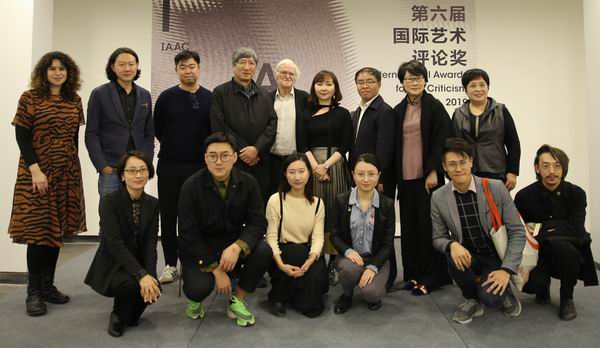
On November 12th, the awarding ceremony of the 6th International Art Criticism Award (IAAC) was held in Shanghai Minsheng Modern Art Museum. The International Art Criticism Award (IAAC) has been held for six times so far. At this award ceremony, Minsheng Art Museum held a dialogue entitled "The Role Orientation of Art Criticism Education" to discuss the significance of artistic writing in education and the current society. The judges of the International Art Criticism Award (IAAC) reviewed and commented on the winning articles, and put forward their own views on the writing method of art criticism.

Comments on IAAC6 submissions and award-winning articles from right: Shao Yiyang, Chantal Faust, Henry Meyric Hughes, Fei Dawei and Weng Zijian.

Nadim Samman, who lives in Berlin, won the grand prize and a short stay in Shanghai or London for his article "Oh You Pretty Things". Tom Trevor, a curator and writer from Britain, relied on the article Cook’s New Clothes, and Pu Yingwei, an artist and writer from China, relied on the article Imperial Heritage-On Pacing: Seventy Years and Silence, and Li Suchao, an art writer and translator, relied on the article Calling the Soul of Gwangju-the former military of Gwangju as an art field.

Six chapters presented by the second prize winner on the exhibition "Pacing: Seventy Years’ Walk", photocopying of the exhibition manual and exhibition.

The Paper learned that since its sixth session, the International Art Criticism Award has received 1,359 valid manuscripts from 69 countries and regions around the world, and 20 winners and 87 finalists have been judged, including curators, artists, writers, freelance writers, teachers, students, artists and enthusiasts from different fields and different identities.

The role orientation of art criticism education

The dialogue on "The Role Orientation of Art Criticism Education" was presided over by Ling Min, a professor in the Department of History and Theory of the Academy of Fine Arts of Shanghai University. Shao Yiyang, vice president of the School of Humanities of the Central Academy of Fine Arts, and Chantal Faust, a research tutor of the Royal Academy of Art, discussed the significance of artistic writing in education and the present society.

In Shao Yiyang’s view, contemporary art research is also a part of art theory and art history, and modern and contemporary art cannot be narrowly attributed to art criticism. She said, "I am very happy to see that more and more young writers and freelancers have done very good art criticism. Now, because there are more free platforms, just like WeChat and Weibo, there are many more free artistic criticisms, and these platforms are also helping young authors to make a voice. "

Architectural appearance of royal college of art

Chantal Foest of the Royal Academy of Art, on the other hand, started from teaching. She said, "Now everyone’s writing concept of art criticism has been extended a lot, and the whole scope and understanding have been greatly supplemented and expanded. When we teach some art criticism writing, we always lead them to practice and practice. We regard words as materials in our hands, and you can use these materials to create an article, which can also make us think deeply about how to position these subjects that teach art theory and critical writing in an art school. Such a position should bring a lot of extensibility and possibilities. In operation, we will also have some joint creations. For example, writers of artistic criticism can create side by side with artists and designers. "

Dialogue: The role orientation of art criticism education from the right: Chantal Faust, Shao Yiyang and Ling Min.

Regarding teaching and theory, Shao Yiyang expressed the hope to offer courses similar to art criticism for artists who specialize in practice, "because we in China are flawed in creativity and creativity. Foreign countries have been trained in creative writing since childhood, and there are different categories of academic, literary and creative writing, but we lack the category of creative writing in China. Creative writing is very important in art criticism. " At the same time, when talking about the comments on artists who have just been released and their works, Shao Yiyang believes that he pays more attention to explaining their works. "The real artistic criticism should not be directed at individuals, but should be at a distance. For a certain artistic phenomenon, an art exhibition is not a famous, flattering or abusive one. I think there are still many places to go in China. "

"In fact, there are two kinds of artistic criticism, one is judgmental and the other is in-depth interpretation. Criticism in English is not only negative, but also a kind of in-depth interpretation. In-depth interpretation is not equal to support. The works it interprets are very important, and the works are very important. It needs theorists and critics to explain it to the public. Of course, art criticism plays a very important role. On the one hand, we can criticize some social phenomena, comment on some art activities and some art problems, and spur them to help the art world do better. For example, art institutions do better, artists do better, and the public understands works of art more. Writing is not to show off the theory, but to combine the theory for a deeper interpretation. " Shao Yiyang said.

2018 Gwangju Biennale "Imaginary Boundary" Exhibition Site

In this regard, chantal believes that art criticism has different forms and categories, and the traditional practice is similar to news writing, which states the positive and negative impressions of artists or works in a concise and clear way. At the same time, she believes that artistic writing will also be more complicated. "For example, artistic criticism itself is also a work. In fact, it can make mutual achievements with the artist’s own works, or learn from each other. We are now facing many challenges and crises that need to be solved urgently, even some unprecedented big difficulties. Therefore, we should gather strength through some thinking like artistic criticism, artistic writing and even artistry to make a sound and play a role. "

Self-awareness and creativity required for artistic writing

In the afternoon, the judges of the International Art Criticism Award (IAAC) reviewed and commented on the winning articles, and put forward their own views on the writing method of art criticism.

Henry MeyricHughes, chairman of the organizing Committee of the international art criticism award, announced the winners

Fei Dawei, an art critic and planner, said that the general quality of Chinese contributions still needs to be improved, but there are still many articles of medium level. These articles lack individuality and are relatively standard writing methods. "In art criticism, you should exercise your judgment and interpretation ability. This interpretation ability is not only a formal integrity, but also your own unique views, luminous views and creative views, and you can elaborate these views in depth."

Christian boltanski "Memory House" exhibition site, Shanghai Museum of Contemporary Art.

Henry Meyric Hughes, honorary chairman of the International Art Criticism Association and chairman of the organizing committee of the International Art Criticism Award, said that artistic writing is not just about doing the work beside artworks, but needs to make a sound like "ownership". "The writing of art criticism should not be a mode like scientific writing, not a closed-loop writing mode, but should have originality and the author’s self-awareness in it, which can better help more audiences understand some works of art."

Weng Zijian, a senior researcher at the Asian Art Literature Library, said, "Art writing needs to cite artistic theories, popular cultural elements and critical theories properly. If it is cited too much, the author’s own views will be lost." At the same time, Weng Zijian also raised questions about the definition, responsibility and ethical thinking of artistic writing. First, is the article too well written? Better than the object, exhibition or work he reviews? Are the two equal? Second, the article should respond to some big discussions and issues in the art world, rather than "zombie formalism."

Shao Yiyang talked about the current problems of art criticism writing in China. In her opinion, some writing ideas are good, creative and critical, but there is a lack of writing methods and references and basis in judging some problems, while students with college background are very modest and not critical enough in choosing topics.

On-site guests take photos with winners and finalists.

At the end of the forum, Henry merrick Hughes talked about the pervasive social media, which also influenced our writing style. "We are now living in a selfie era, and everyone uses selfies or friends to make voices on social media. However, as an art criticism, writing still needs to be slowed down, and there is a process of digestion. Don’t follow the crowd too much, stop and think. "

The whole province is linked with forest fire risk in red warning signal! The weather in Shenzhen in the coming week …

Recently,

Cold air hits Guangdong

Also visit our Shenzhen frequently.

Cotton-padded jacket, sweater, autumn clothes

All the equipment in the closet is taken out.

Although there is still a feeling of autumn and winter in the morning and evening these two days.

But the warm sunshine during the day

Do you feel particularly comfortable?

The weather is too good to be true

▲ Shenzhen released Niu Wei photo

Blue sky and white clouds during the day, clear sky in Wan Li.

At sunset, at dawn,

Yellowing hazy, as if slightly tipsy.

And it’s going to heat up a little recently!

On the 10th, the highest temperature in Guangdong was fixed at Tai Po in the north.

It is 24.9℃

Occupy a place in the national high temperature list

In the last three days

The weather in the province continues to be sunny and dry.

The temperature rose slightly.

Temperature rise

Be in a comfortable state of neither too hot nor too cold.

But dryness is still a topic that the whole province attaches great importance to.

At 15 o’clock on the 10 th, since the second half of the year

For the first time, the whole province is neatly hung

Forest fire danger red warning signal

this morning

The whole province is also neatly red.

The red forest fire in red warning signal.

It is still in force.

A piece of red is to tell you seriously.

Always pay attention to the safety of using fire

Be a good boy.

There have been 25 forest fires in the province since September.

There has been basically no effective precipitation in Guangdong for 90 consecutive days, and adverse weather such as drought and strong wind has increased, and the meteorological level of forest fire danger has remained at a high level. The water content of vegetation decreases, the air humidity decreases, and a slight spark will cause a fire.

The Provincial Forestry Bureau believes that with the arrival of winter, a large number of plants and trees have died, and the combustible materials in the forest have greatly exceeded the warning line of 30 tons per hectare, and the use of fire in the field, such as burning miscellaneous crops, heating engineers, and forest tourism picnics, has increased.

According to the Provincial Forestry Bureau, since September alone, there have been 25 fires in the province, showing an obvious upward trend. In the past week, there have been continuous fires in Foshan, Heyuan, Maoming, Zhaoqing, Huizhou, Shaoguan, Zhanjiang and Jiangmen in our province, and Guangdong accounted for 51% of the national forest fires. Among them, on December 5, two major fires broke out in Gaoming District of Foshan City and Lianping County of Heyuan City. Although they have all been extinguished, the situation of forest fire prevention in the province is still particularly grim.

No typhoon landing, high sub-intensity, weak cold air, high temperature and little rain.

Wu Hongyu, chief expert of Guangdong Climate Center, said that since mid-September (September 16-December 9), the average rainfall in the whole province has been 68.4 mm, which is 62% less than normal (average from 1981 to 2010, the same below). Among them, 16 cities and counties such as Qingyuan, Renhua and Nanxiong have the lowest rainfall in the same period in history. The average temperature in the province is 22.3℃, which is 0.5℃ higher than normal.

Since mid-September, the temperature has been high and the rain has been low, and the meteorological drought in Guangdong has continued to develop. On December 5-6, there was a small to moderate precipitation process in southeastern Guangdong, and the meteorological drought in the southeast was alleviated to some extent. The meteorological drought monitoring in Guangdong Province on December 10th showed that except for the mild drought in southeast Guangdong, moderate to severe meteorological drought occurred in most areas of our province, especially in some counties and cities of Maoming and Yunfu.

"Since September, no typhoon has landed or seriously affected our province. At the same time, the intensity of the western Pacific subtropical high is stronger than normal, and its position is west, which controls our province. In addition, the frequency of cold air affecting Guangdong from the south is less and its intensity is obviously weak. The above reasons have led to significantly less precipitation in our province and significantly higher temperatures. " Wu Hongyu concluded.

Meteorological drought will still be maintained or developed.

Under the comprehensive influence of a series of factors, the average relative humidity in the whole province has been 50.4% since December (December 1-9), which is 19.1% lower than normal. Especially from December 3 to 7, the average daily relative humidity in the whole province was below 50%, of which only 38.8% was on the 6th.

At present, it is in the dry and rainy season, and the meteorological level of forest fire danger is high. Strengthen the work related to forest fire prevention, put an end to the use of fire in the wild, and pay attention to the safety of fire at home. Moreover, dryness can easily lead to bronchitis and other respiratory diseases, and it can also make many people feel chapped and itchy skin, so we should pay attention to moisturizing.

According to the forecast of the Provincial Meteorological Observatory, from December 11th to 14th, the dry weather in most parts of our province was maintained, and the temperature rose slightly, but the temperature difference between day and night was large, and it was still cold in the morning and evening. Wu Hongyu believes that the meteorological drought in Guangdong will still be maintained or developed in the future.

What is meteorological drought?

Drought and meteorological drought are actually two different concepts. Generally speaking, meteorological drought means less rain, and the drought we talk about is more about less rain leading to less water, which in turn leads to the destruction of production economy such as crop production reduction. Meteorological drought is an important cause of drought, but it does not necessarily lead to drought.

Meteorological drought is also called atmospheric drought. According to the national standard of meteorological drought in People’s Republic of China (PRC), meteorological drought refers to the phenomenon of water shortage caused by the imbalance between evaporation and precipitation in a certain period of time, and the water expenditure is greater than the water income. Meteorological drought is usually mainly based on the shortage of precipitation. The most intuitive manifestation of meteorological drought is the reduction of precipitation. The decrease of precipitation is not only the root cause of meteorological drought, but also an important natural factor that causes other types of drought.

One-week weather forecast in Shenzhen

According to the Shenzhen Meteorological Observatory at 10: 00 on the 11th.

On the 12th to 13th, it was cloudy and the air was dry.

The temperature continues to rise;

On 14th-17th, the cloud cover increased and the humidity increased.

The dryness will be relieved and the weather will get warmer.

Large temperature difference between day and night

Dry climate

Everyone continues to do a good job of hydrating and preventing cold in the morning and evening ~

Content source: Shenzhen released comprehensive Guangdong release, Guangdong weather, Shenzhen weather and other reports.

If you need to reprint, please indicate the above contents.

Original title: "The whole province is linked with forest fire risk in red warning signal! The weather in Shenzhen in the coming week … "

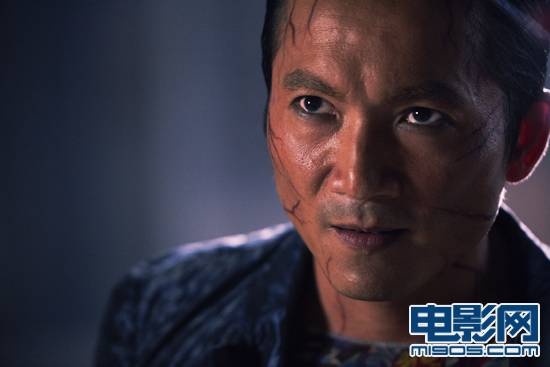
The latest stills of "City Alert" expose the variation, and the veins stand out.


Stills of "City Alert"


Zou Zhaolong plays the mutant demon.


  From Hollywood to Hollywood, the martial arts stunts displayed by Zou Zhaolong, a kung fu superstar, have long been deeply rooted in people’s hearts. His martial arts movements are crisp and beautiful, strong and explosive, and he has a heavyweight position in Chinese action movies. In "City Alert" directed by director Chen Musheng, Zou Zhaolong still plays the villain in the role he used to play in the past.

  Zou Zhaolong’s mutant is Zhang Dachu, who was originally an actor in a circus. During a treasure hunt, he was exposed to the poisonous gas left by the Japanese army during World War II, and turned into a mutant demon with super powers. He resorted to unscrupulous means to rob jewelry, rob banks and kill people, which made people feel chilling. In fact, Zhang Dachu, played by Zou Zhaolong in the film, was still a handsome man who thought he had a handsome appearance in his early days and pretended to be a lover. In the film, I fell in love with Angel played by Shu Qi at first sight, and regarded sunny played by Aaron Kwok as my rival in love. After becoming a mutant with super powers, Zhang Dachu’s image became more and more horrible, and he led his own mutant army with super powers to satisfy his ambition and greed, turning Hong Kong into a city of doom.

  Zou Zhaolong’s modeling in the film also broke the tough image in the previous urban action movies. Through special effects makeup, he gradually turned his appearance into a mutant demon with extraordinary muscles, bursting veins and bursting blood, and his appearance was quite horrible. This style is definitely a breakthrough of Zou Zhaolong’s personal acting career. Director Chen Musheng also commented on Zou Zhaolong’s "his kung fu is very beautiful, and he is definitely a super star player". We are also looking forward to Zou Zhaolong’s magic style and super action in the film, fully demonstrating his future strength in forbidden kingdom.

More wonderful stills on the next page!

On clarifying the limitation of action | litigation help

Shanghai Minhang court helped by original lawsuit.

Litigation help

The limitation of action system means that if the subject of rights fails to take legal action to safeguard his rights within a specific period stipulated by law, his right to request judicial relief will be extinguished. In short, the system aims to urge the subjects of rights to actively exercise their rights, so as to avoid that the rights cannot be realized through judicial channels due to slackness. Although the right itself has not been extinguished by the completion of the limitation, the obligee will lose the legal qualification to obtain a successful judgment through litigation.

First, the limitation period of ordinary litigation

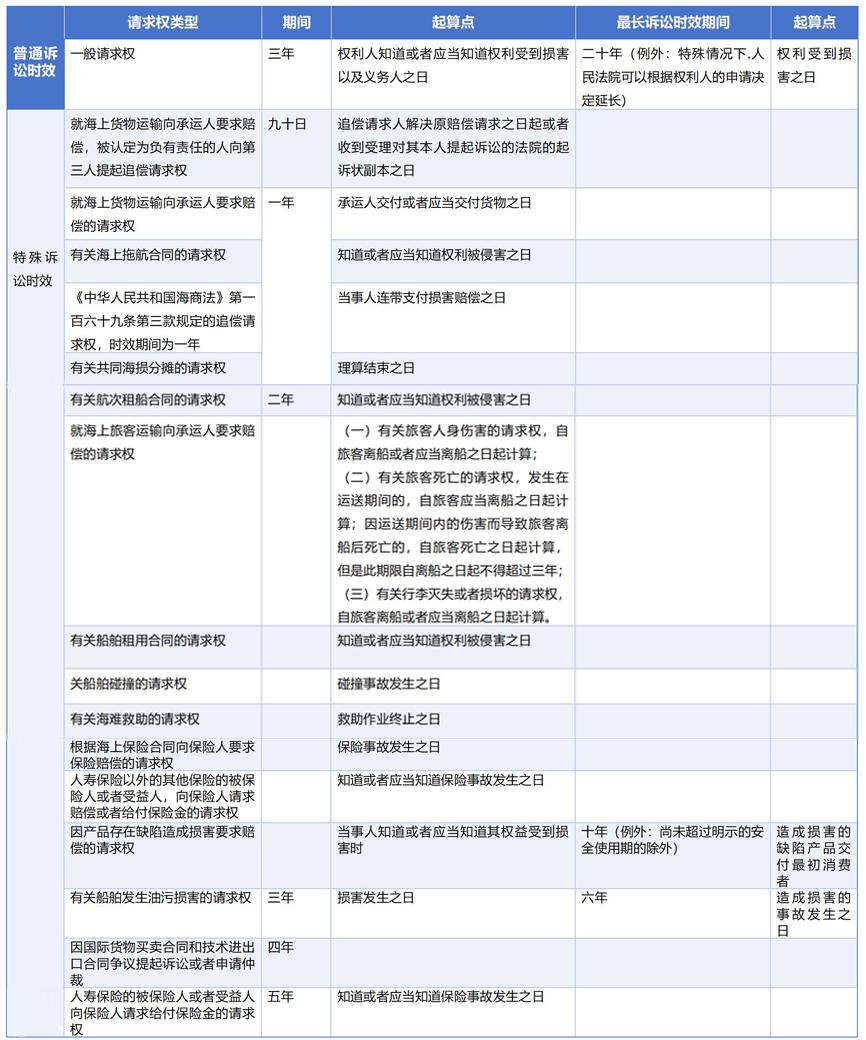
According to Article 188 of the Civil Code of People’s Republic of China (PRC), the limitation period of ordinary litigation is three years, counting from the day when the obligee knows or should know that the right has been damaged and the obligor.

Second, the limitation period of special litigation

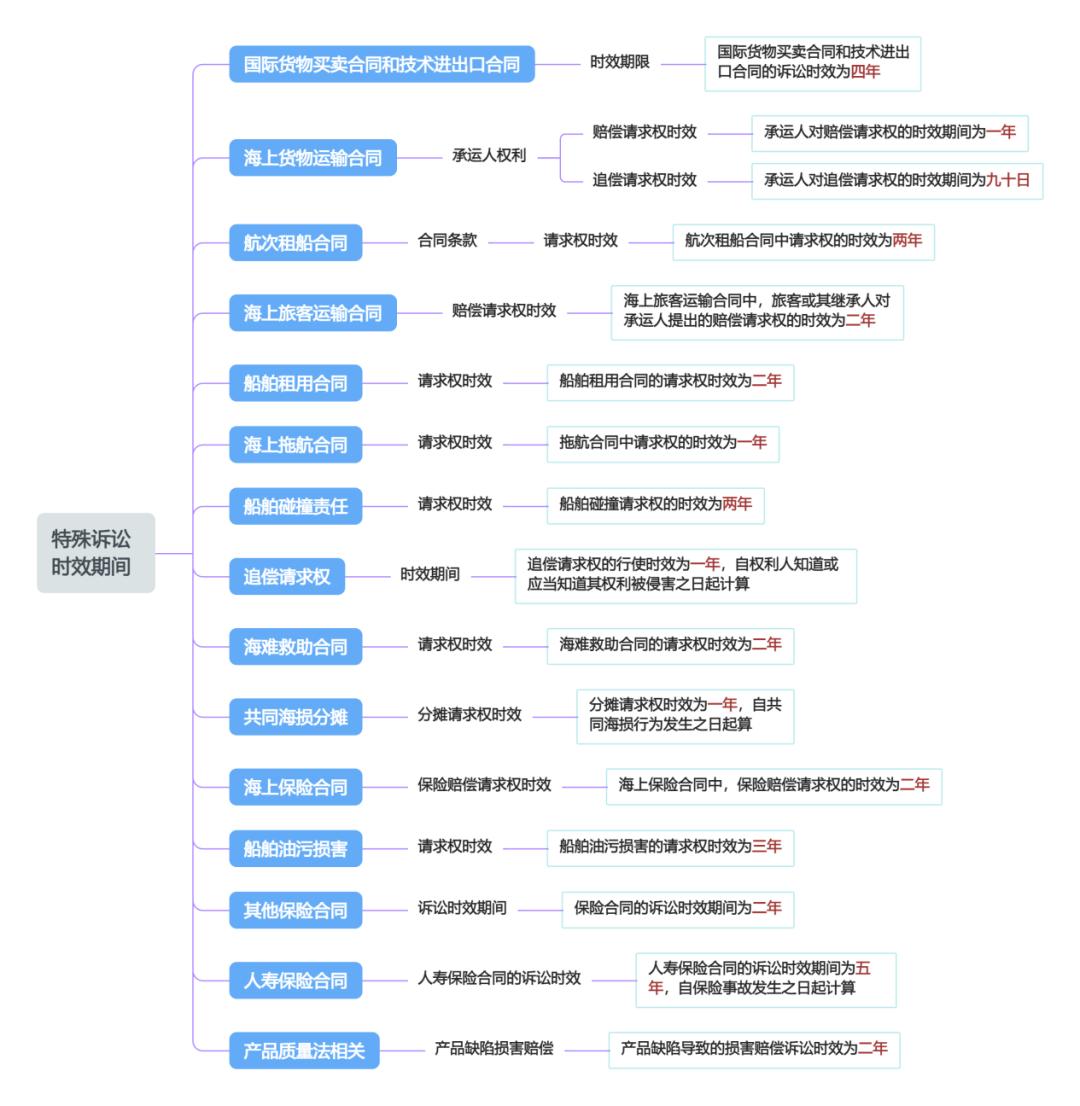
The law also provides for a special statute of limitations:

● The limitation of action for bringing a lawsuit or applying for arbitration due to disputes over international contracts for the sale of goods and technology import and export contracts is four years;

● The limitation period for the claim for compensation from the carrier in the carriage of goods by sea is one year, and for the claim for compensation from a third party by the person deemed responsible, the limitation period is 90 days, and for the claim for voyage charter party, the limitation period is two years;

● The limitation period for claiming compensation from the carrier for the carriage of passengers by sea is two years;

● The limitation period for claims related to ship charter contracts is two years;

● The limitation period for claims related to towage contracts at sea is one year;

● The limitation period for claims related to ship collision is two years; The limitation period for the right of claim for recovery stipulated in the third paragraph of Article 169 of the Civil Code of People’s Republic of China (PRC) is one year;

● The limitation period for claims related to salvage at sea is two years;

● The limitation period for claims related to general average contribution is one year;

● The limitation period for claiming insurance compensation from the insurer according to the marine insurance contract is two years;

● The limitation period for claims for oil pollution damage to ships is three years.

Swipe up to read

Maritime Code of People’s Republic of China (PRC)

Article 257 The limitation period for claiming compensation from the carrier for the carriage of goods by sea is one year, counting from the date when the carrier delivered or should have delivered the goods; If, within the limitation period or after the expiration of the limitation period, the person deemed to be responsible files a claim for compensation with a third party, the limitation period shall be 90 days, counting from the date when the claimant solves the original claim for compensation or receives a copy of the complaint filed by the court that accepted the lawsuit against him.

The limitation period for claims related to voyage chartering contracts is two years, counting from the day when you know or should know that your rights have been infringed.

Article 258 The limitation period for claiming compensation from the carrier for the carriage of passengers by sea is two years, which shall be calculated in accordance with the following provisions:

(1) The claim for personal injury of passengers shall be counted from the day when the passengers disembark or should disembark;

(2) If the claim for the death of the passenger occurred during the period of transportation, it shall be counted from the date when the passenger should leave the ship; If the passenger dies after disembarking due to injury during the transportation period, it shall be counted from the date of the passenger’s death, but this period shall not exceed three years from the date of disembarkation;

(3) The claim for loss of or damage to luggage shall be counted from the day when the passenger disembarked or should disembark.

Article 259 The limitation period for claims relating to ship chartering contracts is two years, counting from the day when you know or should know that your rights have been infringed.

Article 260 The limitation period for claims relating to a contract of towage by sea is one year, counting from the day when you know or should know that your rights have been infringed.

Article 261 The limitation period for claims related to ship collision is two years, counting from the date of the collision accident; The limitation period for the right of claim for recovery stipulated in the third paragraph of Article 169 of this Law is one year, counting from the date when the parties jointly pay damages.

Article 262 The limitation period for claims for salvage at sea is two years, counting from the date of termination of salvage operations.

Article 263 The limitation period for claims for contribution in general average is one year, counting from the date when the self-care calculation ends.

Article 264 The limitation period for claiming insurance compensation from the insurer under the marine insurance contract is two years, counting from the date of the insured accident.

Article 265 The limitation period for claims for oil pollution damage to ships is three years, counting from the date of the damage; However, in no case shall the limitation period exceed six years from the date of the accident that caused the damage.

● The limitation period for the insured or beneficiary of insurance other than life insurance to claim compensation or pay insurance benefits from the insurer is two years, and the limitation period for the insured or beneficiary of life insurance to ask for payment of insurance benefits from the insurer is five years;

● The limitation period for claiming damages due to product defects is two years.

Swipe up to read

Insurance Law of People’s Republic of China (PRC)

Article 26 The limitation of action for the insured or beneficiary of insurance other than life insurance to claim compensation or pay insurance money from the insurer is two years, counting from the day when he knows or should know the occurrence of the insured accident.

The limitation of action for the insured or beneficiary of life insurance to ask the insurer to pay the insurance money is five years, counting from the day when he knows or should know that the insurance accident happened.

People’s Republic of China (PRC) Product Quality Law

Article 45 The limitation period for claiming damages due to product defects is two years, counting from the time when the parties know or should know that their rights and interests have been damaged.

The right to claim compensation for damage caused by defective products shall be lost ten years after the defective products that caused the damage were delivered to the original consumers; However, it is not beyond the express safe use period.

Illustration of limitation period of special action

Third, the longest statute of limitations

The longest limitation period of action is the longest period during which the obligee can claim his rights. According to Article 188 of the Civil Code of People’s Republic of China (PRC), the longest limitation period of action is 20 years, unless in special circumstances, the people’s court may extend it upon the application of the obligee. If more than 20 years have passed since the date of the damage, and the general limitation period expires, the obligee will lose the right to win the lawsuit. However, under certain circumstances, the limitation of action may be shorter than 20 years. For example, Article 265 of People’s Republic of China (PRC) Maritime Code clearly states that the longest limitation of action involving the claim for compensation for oil pollution damage from ships shall not exceed six years from the date of the damage accident under any circumstances. In addition, Article 45 of the Product Quality Law of People’s Republic of China (PRC) also stipulates that the right to claim compensation for damage caused by product defects shall be lost ten years after the defective products are delivered to the original consumers; Unless the product has not exceeded its express safe use period.

Diagram of the longest limitation of action

Fourth, the scope of application of the statute of limitations

First, only the right of claim is subject to the statute of limitations

The right of claim refers to the right of a specific person to ask a specific person to do or not do a specific act based on certain basic rights. The subject of rights and obligations are specific, and the right of claim is relative in principle.

It should be noted that the limitation of action does not apply to the right to claim control, but according to Article 196 of the Civil Code of People’s Republic of China (PRC), the limitation of action applies to the right holder who requests to return the property based on the unregistered movable property right (the right to claim the original property).

Tips

In principle, all claims for creditor’s rights are subject to the limitation of action, but Article 196 of the Civil Code of People’s Republic of China (PRC), Article 1 of the Provisions of the Supreme People’s Court on Several Issues Concerning the Application of the Limitation of Action System in the Trial of Civil Cases and the Supreme People’s Court’s Application

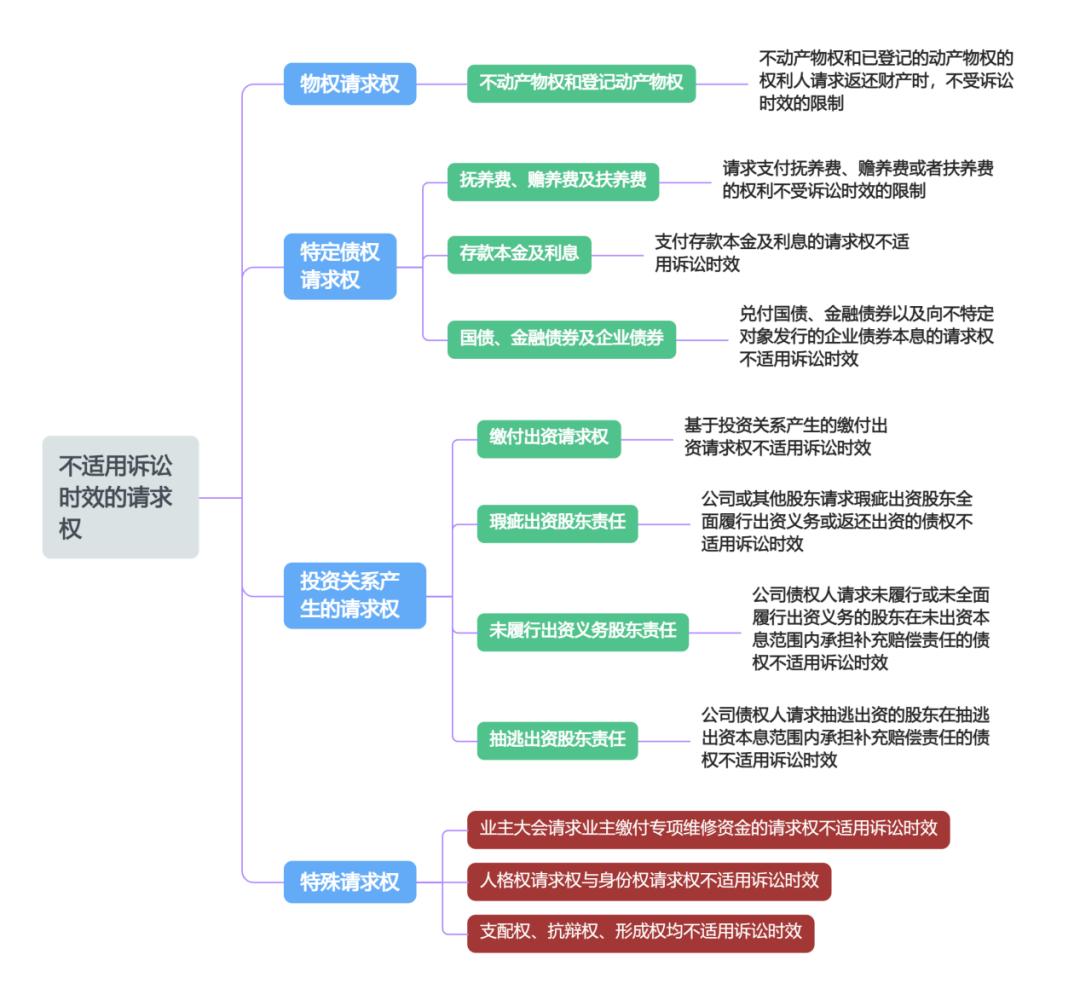
Provisions on Several Issues of People’s Republic of China (PRC) Company Law (III) Article 19 stipulates that the following types of claims for creditor’s rights are not subject to the statute of limitations:

1. The obligee of immovable property right and registered movable property right requests to return the property;

2. Request to pay alimony, alimony or alimony;

3. Claim for payment of deposit principal and interest;

4. The right to claim the principal and interest of treasury bonds, financial bonds and corporate bonds issued to unspecified objects;

5. Claims for capital contribution arising from investment relationship;

6. The company or other shareholders request the shareholders with defective capital contribution to fully fulfill their capital contribution obligations or return the creditor’s rights of capital contribution to the company;

7. The creditor’s rights of the company requesting the shareholders who have not fulfilled or fully fulfilled their capital contribution obligations (shareholders with defective capital contribution) to bear supplementary compensation liability for the part of the company’s debts that cannot be paid off within the scope of unfunded principal and interest;

8. The creditor’s rights of the company requesting the shareholders who withdraw their capital contribution to bear supplementary liability for the unpaid part of the company’s debts within the scope of withdrawing their capital contribution principal and interest.

As for the nature of "requesting to stop the infringement, removing the obstruction and eliminating the danger" in the first paragraph of Article 196 of the Civil Code of People’s Republic of China (PRC), combined with the provisions of Article 236 of the Property Rights of the Civil Code of People’s Republic of China (PRC) (Article 236 impairs or may impair the property rights, The obligee may request to remove the obstruction or eliminate the danger) and Article 167 of Tort Liability of People’s Republic of China (PRC) Civil Code (Article 167, if the infringement endangers the personal and property safety of others, the infringed has the right to request the infringer to undertake the tort liability such as stopping the infringement, removing the obstruction and eliminating the danger). The nature of the right to stop the infringement here should be the right to claim the tort debt. To eliminate the obstruction and danger, it should be defined as the claim of real right and the claim of tort debt according to the provisions of Article 236 of the real right series or Article 167 of the tort liability series, but no matter what the nature, the statute of limitations is not applicable according to the provisions of Article 196 of the Civil Code of People’s Republic of China (PRC).

In addition, according to the 14th batch of guiding cases issued by the Supreme People’s Court:

Five cases (Guiding CasesNo. 65-69), including the case of owners’ meeting of Jiule Building Community in Hongkou District of Shanghai v. Shanghai Huanya Industrial Corporation.

Referee points:

Special maintenance funds are used for the maintenance, renewal and transformation of shared parts and shared facilities and equipment after the warranty period expires, and belong to all owners. Paying special maintenance funds is a legal obligation for owners to maintain the long-term safe use of buildings. If the owner refuses to pay the special maintenance fund and raises a defense with the limitation of action, the people’s court will not support it.

Therefore, the limitation of action does not apply to the owners’ right to request the owners to pay special maintenance funds.

Second, the limitation of action does not apply to the right of personality and the right of identity.

Swipe up to read

Civil Code of People’s Republic of China (PRC)

Article 196 The limitation of action shall not apply to the following claims:

(a) request to stop the infringement, remove obstacles and eliminate dangers;

(2) The obligee of immovable property right and registered movable property right requests to return the property;

(3) Requesting to pay alimony, alimony or alimony;

(four) other claims that are not applicable to the limitation of action according to law.

Article 236 Where the property right is impaired or may be impaired, the obligee may request that the obstruction or danger be eliminated.

Article 995 Where the right of personality is infringed, the victim has the right to request the actor to bear civil liability in accordance with the provisions of this Law and other laws. The limitation of action does not apply to the victim’s right to stop the infringement, remove the obstruction, eliminate the danger, eliminate the influence, restore his reputation and apologize.

Article 101 The protection of the identity rights of natural persons arising from marriage and family relations shall be governed by the relevant provisions of Parts I and V of this Law and other laws; If there are no provisions, the relevant provisions on the protection of personality rights in this part can be applied according to their nature.

Article 167 Where an infringement endangers the personal and property safety of others, the infringed party has the right to request the infringer to bear the tort liability of stopping the infringement, removing the obstruction and eliminating the danger.

Three, the right of domination, the right of defense and the right of formation are not applicable to the statute of limitations.

Domination refers to the right of the obligee to directly control the object of rights, enjoy specific interests and exclude others’ interference, such as property right, personality right, identity right, intellectual property right, network virtual property, etc. The reason why the limitation of action does not apply to domination is because the existence of domination itself is the purpose of existence, and the realization of rights is direct, which can be realized only by the will of the obligee, without the obligor’s active behavior, but only by asking others to do nothing.

The right of defense is a defensive right, which can only achieve the purpose of refusing to pay when the obligee requests. Its function is to hinder the realization of the right of claim, and the right of defense has the characteristics of permanence.

The right of formation is the right to change an existing legal relationship according to the unilateral will of the obligee without the participation of others. For example, the right of claim for the division of co-ownership stipulated in Article 303 of the Civil Code of People’s Republic of China (PRC), the preemptive right of co-owners by shares stipulated in Article 305, the right of ratification in contracts with pending validity stipulated in Articles 145 and 171 and the cancellation right of bona fide counterpart in contracts with pending validity, the cancellation right of revocable legal acts stipulated in Article 152, and the choice right of debt of choice stipulated in Article 515. The statutory right of set-off stipulated in Article 568, the statutory right of rescission and the agreed right of rescission stipulated in Articles 562 and 563, the buyer’s approval right in the trial sales contract stipulated in Article 638, the lessee’s preemptive right in the house lease contract stipulated in Article 726, and the third party’s option in the indirect agency stipulated in Article 926. The revocation right in revocable marriage stipulated in Articles 1052 and 1053, the right to divorce in Article 1079, the right to dissolve the adoption relationship in Articles 114 and 115 of the Civil Code, the right to withdraw and change the will in Article 142, and the right to divide the estate.

Illustration of claim right without limitation of action

V. Interruption and suspension of limitation of action

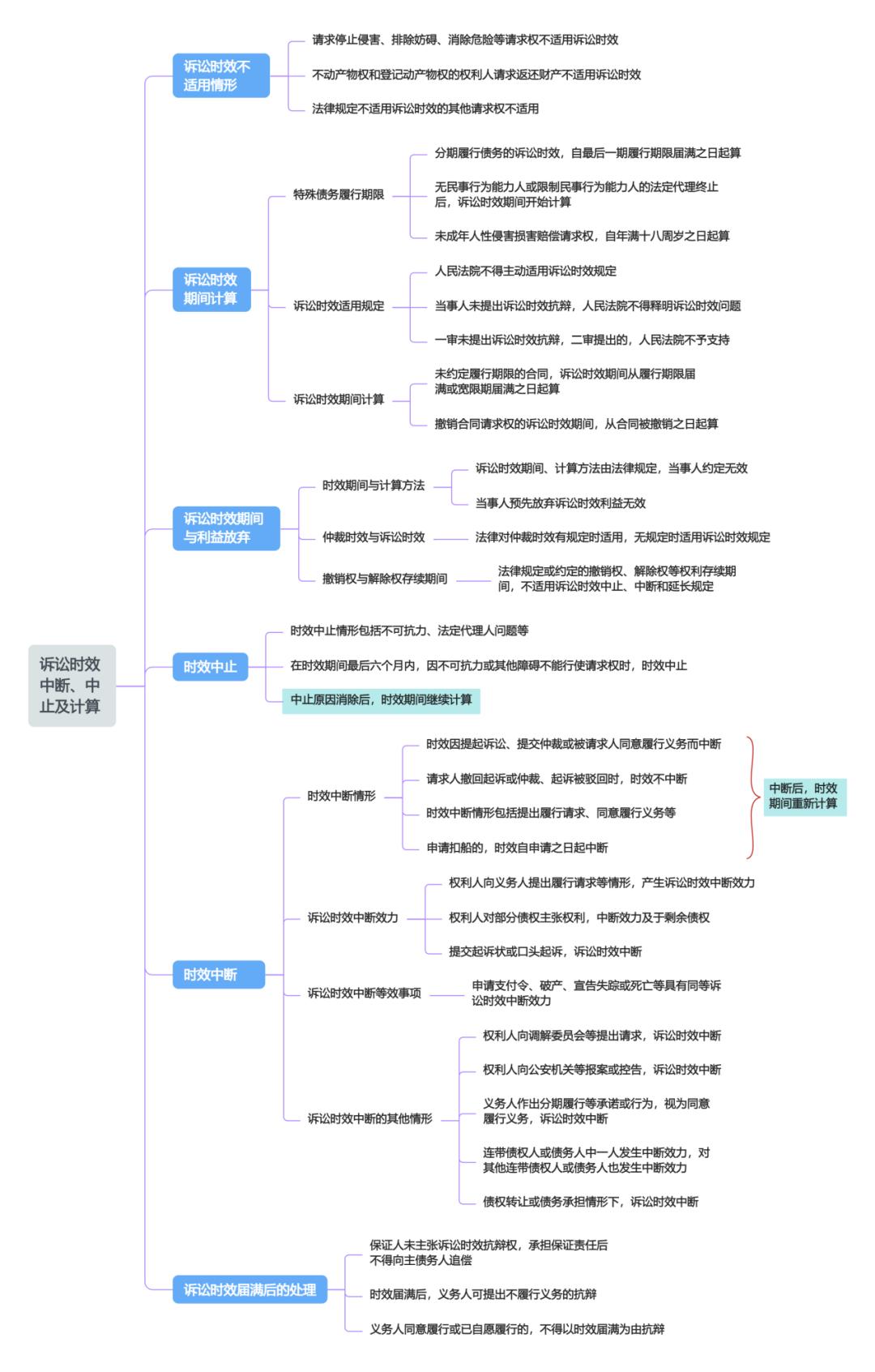
The interruption and suspension of the calculation of the limitation of action refers to the legal system in which the limitation of action is recalculated due to the occurrence of specific reasons. Specifically, the interruption of the limitation of action means that during the limitation of action, due to the emergence of legal reasons such as the obligee filing a lawsuit and the debtor acknowledging the debt, the limitation period that has been carried out is invalid and the limitation of action is calculated again. The suspension of the limitation of action refers to the temporary suspension of the calculation of the limitation period due to force majeure or other legal reasons during the limitation of action, and the calculation will continue after the cause is eliminated. These two systems are designed to protect the legitimate rights and interests of obligees and prevent obligees from losing their litigation rights due to the lapse of the limitation period.

Tips

One, the following circumstances should be regarded as "the obligee puts forward a request for performance to the obligor" referred to in Article 195 of the Civil Code of People’s Republic of China (PRC), which leads to the interruption of the limitation of action:

1. The parties directly send the documents claiming rights to the other party, and the other party signs, seals, fingerprints or otherwise proves that the documents have been delivered (if the other party is a legal person or other organization, the signatory may be its legal representative, principal responsible person, department responsible for sending and receiving letters or authorized subject; If the other party is a natural person, the signatory can be the natural person himself, a relative with full capacity living together or an authorized subject. When the obligee claims the same part of the creditor’s rights, the interruption effect of the limitation of action extends to the remaining creditor’s rights, unless the obligee explicitly waives the remaining creditor’s rights. If the parties submit a complaint or oral prosecution to the court, the limitation of action shall be interrupted from the date of prosecution);

2. The parties claim their rights by letter or data message, and the letter or data message has arrived or should have arrived at the other party;

3. The parties are financial institutions, and the principal and interest of arrears are deducted from the other party’s account according to law or agreement;

4. The whereabouts of the parties are unknown, and the other party publishes a notice of claiming rights in influential media at the national or provincial level, unless there are special provisions in laws and judicial interpretations.

Two, the right subject to the people’s mediation committee or other state organs, institutions and social organizations with the function of solving civil disputes, the limitation of action shall be interrupted from the date of the request. When the right subject reports or complains to the public security organ, the people’s procuratorate or the people’s court to request the protection of civil rights, the limitation of action shall be interrupted from the date of reporting or complaining. If the above-mentioned authorities make a decision not to file a case, dismiss the case or prosecute, the limitation of action will be recalculated from the date when the right subject knows or should know; If a criminal case enters the trial stage, the limitation of action will be recalculated from the date when the criminal judgment document takes effect.

Three, the following matters shall be deemed to have the same effect of interruption of the statute of limitations as bringing a lawsuit:

1. Apply for a payment order;

2. Apply for bankruptcy and declare bankruptcy claims;

3. Apply for declaring the obligor missing or dead;

4. Apply for pre-litigation property preservation, pre-litigation temporary injunction and other measures;

5. Apply for enforcement;

6. Apply for additional parties or be notified to participate in litigation;

7. Advocating set-off in litigation;

8. Other matters with the same effect of interruption of limitation of action, etc.

Swipe up to read

Civil Code of People’s Republic of China (PRC)

Article 195 If the limitation of action is interrupted in any of the following circumstances, the limitation of action shall be recalculated from the time when the interruption and relevant procedures are terminated:

(1) The obligee makes a request for performance to the obligor;

(2) The obligor agrees to perform the obligation;

(3) The obligee brings a lawsuit or applies for arbitration;

(4) Other circumstances that have the same effect as bringing a lawsuit or applying for arbitration.

● In the case of "the obligor agrees to perform the obligation" stipulated in Article 195 of the Civil Code of People’s Republic of China (PRC), if the obligor makes commitments or acts such as performing by stages, partially performing, providing guarantee, requesting to postpone performance or making a debt repayment plan, it shall be deemed that the limitation of action has been interrupted.

● When one of the joint and several creditors has the cause of interruption of limitation of action, the interruption effect also extends to other joint and several creditors. Similarly, when one of the joint debtors has a cause of interruption of limitation of action, the interruption effect also extends to other joint debtors.

● In the case that the creditor brings a suit of subrogation, the interruption effect of the limitation of action will affect the calculation of the limitation of action of both the creditor and the debtor.

● When the creditor’s rights are transferred, the limitation of action is interrupted from the date when the notice of creditor’s rights transfer reaches the debtor.

● In the case of debt assumption, if it constitutes the original debtor’s acknowledgement of the debt, the limitation of action will be interrupted from the date when the intention of debt assumption reaches the creditor.

● When the limitation of action of the principal debt expires, the guarantor will enjoy the defense right of the limitation of action of the principal debtor. If the guarantor assumes the guarantee responsibility without claiming the right of defense of limitation of action mentioned above and exercises the right of recourse against the principal debtor, the people’s court will not support it unless the principal debtor agrees to pay.

● After the expiration of the limitation period of action, if the parties give their consent to perform their obligations to the other party or voluntarily perform their obligations, and then make a defense on the grounds of the expiration of the limitation period of action, the people’s court will not support it. If the parties reach a new agreement on the original debt, the creditor claims that the obligor waives the right of defense of limitation of action, and the people’s court should support it.

● After the limitation of action expires, if the lender issues a notice to the borrower to call for the loan due, and the debtor signs or seals the notice, it can be concluded that the borrower agrees to perform the obligation that the limitation of action has expired. The people’s court should support the lender’s claim that the borrower waives the right of defense of the limitation of action.

Interruption, suspension and calculation diagram of limitation of action

Source: Duan Wenlan, Wei Sijie, Civil Court

Original title: "One article clarifies the limitation of action | litigation help"

Trump’s net worth plummeted by $2 billion! The share price of "Know the King Concept Stock" was denounced as "a scam"

According to Cailian News, in just half a month, the share price of Trump Media Technology Group (hereinafter referred to as "Trump Media"), the parent company of Trump’s social media Truth Social, turned from skyrocketing to plummeting, and Trump’s own net assets also took a roller coaster ride. More than $2 billion in assets that had soared before were also wiped out in just one week.

Trump Media shares plummeted this month.

At the end of last month, after the reverse merger with a bad check company, Trump Media landed in the US stock market and traded under the DJT stock code.

Due to Trump’s ultra-high traffic, this "backdoor listing" transaction also attracted a lot of attention. The company’s share price also opened 55% higher on the first day of listing and finally closed at 16.%.

Trump media stock price trend

However, this kind of scenery did not last long: since the beginning of this month, the share price of Trump Media Technology Group began to plummet, and almost all the gains since listing have been basically retreated in the last week, which has fallen to the lowest level since the first trading day of listing, down 50% from the peak price of $79.38.

At the same time, Trump’s net worth is rapidly evaporating. Trump owns about 79 million shares of the company, accounting for nearly 60% of its shares.This means that the value of his stock has evaporated by about $2 billion since the stock began to fall sharply on April 1.

This is definitely bad news for Trump. The former president of the United States is currently facing more and more judicial bills. If the stock price of Trump Media continues to decline according to this trend, by the end of the six-month lock-up period, he will have little money to cash out from this stock.

Listing is just "a scam"?

On the first day of Trump Media’s listing, the highest market value was as high as about $10.4 billion, even surpassing Reddit, a social media company that went public a few weeks ago.

However, the company’s fundamental performance obviously does not match its high valuation.

At the beginning of this month, the financial data disclosed by the company showed that the company’s revenue declined and its performance was bleak. By the end of last year, the company had exhausted almost all its funds. Without additional financing, it might not survive, let alone see much potential for future growth.

Many people compared it with some meme stocks and counterfeit coins. Barry Diller, a well-known media tycoon and former chairman of Paramount Film Company, is even more blunt.The listing of this stock is "a scam", and the investors who buy this stock are "idiots". He criticized:

"Investors must have bought this stock without considering the company’s financial situation. They bought it for other reasons. "

Original title: Trump’s net worth plummeted by $2 billion! The share price of "Know the King Concept Stock" was denounced as "a scam"

Editor: Mou Huilan Editor: Zhang Songtao Audit: Feng Fei

Wang Zhenzhong: The only Chinese mentioned in Das Kapital

Shexian Guild Hall in Beijing in the Qing Dynasty was located in Xuanwumenwai Street, where Beijing official Wang Maoyin (No.Zihuai, 1798-1865) once lived. Wang’s official residence in the imperial history made him famous for daring to speak, and later he was promoted to the right assistant minister of the household department. At that time, Su Shun, the powerful minister, was in power, and he was quite afraid of Wang Maoyin, who had a clean name, so he tried to send someone to pull the cage. In this regard, Wang Maoyin was also quite moved at the moment and made an appointment to pay his respects on a certain day. On the appointed day, the middleman arrived early and sat outside the hall waiting to go with him. Wang also had horses and chariots prepared, and he came out wearing a hat. At that time, there was a big mirror in the east of the hall. When Wang Maoyin passed by, he couldn’t help looking at himself up and down carefully. I saw that he had to say to himself, "How can you be a prince?" Then he immediately went back to his bed, excused himself from being ill and sent the lobbyist away …

The above-mentioned plot comes from "Clear Barnyard Notes" compiled by Xu Ke in the Republic of China. The book "Qing’s Banknotes" is full of anecdotes and anecdotes, and many of its contents are quite vivid, but its story source is usually difficult to trace. However, the story of "Wang Maoyin is not in Su Shun" can also be found in "Talking about Things" compiled by Xu Chengyao, a Huizhou historian in Beijing. Xu Shi, a disciple of Wang Zongyi, Wang Maoyin’s son-in-law, made a detailed investigation of the historical sites of Shexian Guild Hall in Beijing. It is said that in the late Qing Dynasty and the Republic of China, when people living in the capital of overseas Chinese mentioned Wang Maoyin, they always pointed to the mirror in the hall and told the above story.

According to the historical facts, in the early years of Xianfeng, Su Shun, the Manchu power minister, was deeply trusted by the emperor. He rebelled against the old rules of his ancestors who "paid more attention to the Han people than to the Han people" and tried his best to convey it to the Han scholar-officials. Therefore, this story may not be an unfounded fiction. However, through this story, people can see a more important point-regardless of the merits and demerits of historical figures, people act in the world, the temptation of fame and fortune, the balance of gains and losses, and the evaluation of fame behind them are sometimes only in a moment. Only when the person concerned looks at himself in the mirror can he best see the secrets in his heart; As historical spectators, the information provided by handed down literature to us bystanders is really quite limited.

Statue of Wang Maoyin in Shexian County

Wang Maoyin is the only Chinese mentioned by Marx in Das Kapital. This person is a native of Shexian County, Huizhou Prefecture. In 1853, he became the right assistant minister of the Ministry of Housing and was also in charge of the affairs of Qianfatang. He was opposed to casting large sums of money, thinking that low-value copper coins would inevitably lead to rising prices, but this suggestion was not adopted by the emperor. In April of the following year, Wang Maoyin once again talked about the banknote law, requesting that the issued non-convertible banknotes be changed into convertible banknotes, and stipulating the maximum amount of issuance, which is conducive to the development of business and the operation of the economy. As a result, he was reprimanded by Emperor Xianfeng as being instructed by businessmen and not caring about state affairs.

Later, Marx learned Wang Maoyin’s proposition from the investigation report of the Russian Embassy in Beijing, and regarded it as a "new material" of monetary theory and history, which was mentioned in the footnote of Volume 1 of Das Kapital:

Wang Maoyin, the right assistant minister of the Qing dynasty, made a memorial to the emperor, advocating secretly changing official tickets and treasure banknotes into cashed banknotes. In the minister’s deliberation report in April 1854, he was severely reprimanded. Whether he was flogged for this is unknown. At the end of the deliberation report, it said: "It is not convenient for China to read the patent dealers in detail."

Because of the mention of Das Kapital, Wang Maoyin’s monetary thought has been concerned by academic circles for more than 80 years since the 1930s, and famous scholars such as Guo Moruo and Wu Han have expressed their opinions on it. However, in the past, the most systematic document on which people based their arguments was the red tape article "Wang Shilang’s Memorial", with little private information, so that we knew little about Wang Maoyin’s life world outside the temple. In view of this, this paper makes use of the newly discovered Correspondence of Ji Yue Xuan to study the daily life of the Huizhou Jing Guan during the period of Xianfeng’s war, hoping to reveal more about Wang’s family background and social contacts through these manuscripts, and to understand the origin of his "monetary thought" from some aspects.

Transcript of Ji Yuexuan’s Correspondence Book Shadow

Brief introduction of Wang Maoyin’s personal letter

One copy of Ji Yuexuan’s Correspondence is a related manuscript of Wang Maoyin from 1855 to 1859. This manuscript belongs to the "letter base" in Huizhou documents. The so-called letter base is a manuscript or transcript formed by copying letters sent by individuals or letters exchanged with each other into a book.

In the traditional era, people have different purposes to trust each other. Generally speaking, businessmen do this out of the need of business operation, mainly for memo, so as to read, refer to and check the accounts when necessary. Scholars, on the other hand, use this to accumulate personal data, and prepare materials for compiling family instructions, last words and even forming a collection of works in the future. As a famous bureaucrat in the same period of Xian, some words in Ji Yue Xuan’s Correspondence were widely circulated.

Because some letters are presented in the form of family instructions and last words, it is not excluded that the author has considered them when writing and copying. Under the immortal self-expectation or psychological suggestion, when writing, people tend to sit still and be dignified, or polish it after copying the final version. However, judging from the letters received in Ji Yue Xuan’s Correspondence, many of them are related to the privacy of family background, which should belong to a relatively primitive "letter base".

In addition, the name of this copy is related to the place where Wang Maoyin lived in Beijing at that time. It is speculated that Wang Maoyin may once live in the Sleeping Buddha Temple in the Western Hills of Beijing, and "Jiyuexuan" is a courtyard in the Sleeping Buddha Temple, so "Jiyuexuan Correspondence" should be the correspondence between Wang Maoyin and Ji Yuexuan during his residence in the Sleeping Buddha Temple from 1855 to 1859.

Daily life of Beijing official Wang Maoyin during the Taiping Heavenly Kingdom.

The 82 correspondence included in Ji Yue Xuan’s Correspondence is the correspondence between Wang Maoyin, his brothers, sons and others with relatives and friends, which covers a wide range of contents. Besides state affairs and family chores, more letters reflect some aspects of Wang Maoyin and his family’s daily life in Beijing during Xianfeng years, which are discussed below.

Donate officials on behalf of others

In order to solve the financial problems, the Ming and Qing governments carried out the donation system and sold various qualifications related to being an official. The most frequent letters in Ji Yue Xuan’s Correspondence are about donating officials.

For example, the fifth letter in the codex is a letter from Qianqiu Guan Dushou and Manchu Alinbao. He said that his son Baoyin wanted to add a donation to the post of judge, and designated it to be distributed to Shandong Province as an alternate. He hoped that Wang Maoyin’s younger brother Wang Mao Ai would donate money for him, and promised that once he got the license, he would return it in all quarters. In the Qing Dynasty, donors would borrow money from Shanxi Bank or other financial institutions in Beijing (such as banks and banks) if they didn’t have enough funds to donate. However, for Alinbao’s request, Wang Mao replied very politely: He buys goods and sends them to Beijing every year, and sends the silver back to Huizhou home after selling them. However, in recent years, due to the poor traffic between the north and the south, the business is sparse, and there is no goods sent to Beijing at home, and Beijing has no silver coins to send back to Huizhou. Therefore, Alinbao’s request to accommodate the silver coins and donate official positions on his behalf is really at a loss. In addition, at that time, the price of silver in Beijing fluctuated, and Jiangnan and Beijing were separated by thousands of miles. It took dozens of days for letters to exchange, and there was no way to communicate with each other at any time, so it was even more difficult to deal with. Judging from the contents of the above two letters, Wang Mao Ai transports tea, Four Treasures of the Study and other local products from his hometown to Beijing through long-distance trafficking every year, and then sells them and returns them to his home. In addition, judging from the basic situation of Beijing’s agency donation at that time, agencies and individuals usually provide money for donors, so Alinbao will make the above request. From this point of view, as the younger brother of Beijing official Wang Maoyin, Wang Mao Ai is indeed a professional businessman who reports donations on behalf of others. Just because he may have limited money,So I refused Alinbao’s request. Of course, it is more likely that the other party is a Manchu, and doing this deal for it will have certain risks.

Regarding the donation of officials, the 13th letter included in Ji Yuexuan’s Correspondence was written by Wang Maoyin from Beijing to his relative Wang Erchang in 1857. The letter mentioned the advantages and disadvantages of the officials donated at that time, the fierce competition for alternate officials, and enlightened the price of donating officials. He earnestly warned that once he was ready to be an official, the ups and downs of his official career were often involuntary and he had to take care of himself. Regarding Wang Erchang’s official donation, the 29th letter of Ji Yuexuan’s Correspondence was written to Wang Maoyin by Wang in Beijing in 1858, in which he mentioned that he had collected 1,500 taels and planned to remit money to Beijing through Wang Yongyi’s silk shop in shengze town. In this regard, Wang Maoyin’s reply from Beijing (the 30th letter) not only talked about the specific situation of donating officials, but also pointed out: as long as you have silver on hand, you don’t have to worry about not being able to remit money to Beijing. This clearly shows that in the 1950s, even during the war, the exchange between Huizhou and Beijing was still quite smooth.

Regarding donation and exchange, the 21st letter was written by Bao Enqi to Wang Ming, the eldest son of Wang Maoyin, in 1857. It was mentioned in the letter that Wang Maoyin had donated a real job for Bao Enqi’s friend, and after it was completed, a letter from Jixi sent 624 Liang. Among them, 600 taels is the money actually spent for donation, while 24 taels is one cent per month, with a total of four months’ interest. It can be seen that Wang Maoyin and his family have also obtained relevant benefits by donating officials on behalf of others. Since then, the 22nd letter should be a letter sent by Wang Ming to an elder named "Yunyou", in which he mentioned that he had received the silver coins brought by a letter from Jixi. Later, he will send a letter to inform Wang Maoyin who is far away in Beijing. All these show that Wang Maoyin donated official positions for people in the capital, while his home in Shexian received silver from the official donors.

In addition to donating officials from fellow villagers, there are also many donors among Wang Maoyin’s closest relatives. The 36th letter was written by Wang Maoyin to the eldest son-in-law Hong Chengji. In the letter, Wang Maoyin first stated that he did not approve of Hong Chengji’s donation of officials. He believes that there are two realms of being an official, one is to be a good official for the country and the people, and the other is to be an official only for personal gain. In his view, being an official should be for the country and the people, not just for personal gain. Having said these truths, Wang Maoyin then made a concrete analysis of the actual situation of Hong Chengji. He thought that Hong had no children at that time, so he was sure to bring his family to Beijing. Being a Beijing official was obviously quite unfavorable, and if he donated foreign officials, there would be great problems. At that time, the candidates who went to the "safe province" (that is, those provinces where there was no war) were overcrowded, and it took a long time to get the official vacancy. In this case, every year in the provincial capital, food and related entertainment must be supplemented and compensated by their own homes. However, if you go to "military affairs to save points", although it is easier to get the job vacancy, it is quite dangerous, sometimes it will make people in a dilemma, or they will lose their lives or be blamed by the court. At that time, Hong Chengji owned stores in other places, while he owned land in his hometown, which was a typical home of Huizhou merchants. In view of this, Wang Maoyin believes that the eldest son-in-law is a well-off family. Unlike those officialdom speculators who "live in debt and die in debt", it is completely unnecessary to take risks by donating officials.

In addition to the eldest son-in-law, Wang Maoyin’s cousin Hongliangcai also has the willingness to donate. The 37th letter of Ji Yuexuan’s Correspondence is a letter he wrote to Hong Liangcai from Beijing. The annex to the letter mentioned the donation entrusted by this cousin. At that time, Hong Liangcai and others remitted the money to Jingshi 50 Liang through Wan Feng Store. In this regard, Wang Maoyin explained the detailed expenses of the fee. This example also shows that the donated expenses are also transferred through the exchange between Beijing and Jiangnan.

In Ji Yuexuan’s Correspondence, there is not only a special list of the price of donating officials, but also discussions in this regard can often be seen in various letters. It can be seen that Wang Maoyin has a very clear understanding of donation and related money price comparison.

Letters on Donation in Ji Yue Xuan’s Correspondence

Request for assistance in litigation

China is a personal society, and in Huizhou, which attaches great importance to nostalgia and clan friendship, Wang Maoyin, as a second-class Beijing official, is inevitably entrusted by people to work for relatives and friends.

Take Wang Maoyin’s closest relative as an example. His family, the Wang family in Qizili, Shexian County, has been married to the Hong family in Sanyangkeng, the same county for generations. Similar to the Wangs, Hongshi is also a family of Huizhou merchants, and there are quite a few businessmen in Tongzhou and Taizhou in northern Jiangsu. The two litigation cases mentioned in Ji Yuexuan’s Correspondence are related to this background.

One of them is "Hong Yisheng Tea Shop Case". Hongyisheng Tea Shop, which was opened in Taizhou, is an ancestral shop of the Hong family in Sanyangkeng, and has always been opened by the second and third houses in the family. In 1835, Fannie and Freddie jointly signed a contract and agreed to operate separately in turn, with each room lasting for ten years. During the Xianfeng period, the manager of Fannie and Freddie, Hong Zaizhong, died, and the store business was inherited by Zaizhong’s son. Changfang learned that Hong had a lot of losses both at home and abroad. Even if all the assets of Hongyisheng Tea Shop were used as collateral, there was still a big gap. In view of this, Changfang is deeply uneasy, fearing that the son of Zhongzhong will use the store industry to pay off debts, and he will lose all his money. In this context, they can only think hard about how to deal with it. Since Hong Benhuai of Changfang is Wang Maoyin’s cousin, he hopes that Wang will come forward to make decisions. After discussion, Hong Benhuai’s statement is: Hongyisheng Tea Shop is the ancestral business of Hongjia, and Changfang owns half of the shares. Previously, Hong Benhuai opened another small shop in Jiangyan Town, east of Taizhou. Due to the shortage of funds, the capital could not be turned over for a while. In 1852, he pawned half of the shares held by Hong Yisheng Tea Shop to his cousin Wang Maoyin. In this case, the third party is added to the property right relationship, hoping to force Fannie and Freddie to be cautious when paying off debts. In this process, Wang Maoyin wrote to the local officials in northern Jiangsu many times through his family, repeatedly emphasizing his interest in this lawsuit, in order to get the necessary care and protect the related rights and interests of his cousin Hong Benhuai.

In addition to the "Hongyisheng Tea Shop Case", Wang Maoyin’s family also intervened in another commercial dispute in northern Jiangsu. In the early 1820s, Wang Maoyin’s relative, Hong Chengming, bought the property right of Hong Dayuan’s cloth shop in Jiangyan Town, and then had a dispute with others for some reason. There are two letters in Ji Yue Xuan’s Correspondence, which are written by Wang Maoyin’s younger brother to a relative who is an official in the local area. In the letter, he cleverly carried out the Beijing official Wang Maoyin, saying that because he lived far away in Beijing and was beyond his reach, he had to turn to this local official for help, which was of course a means of secretly exerting pressure. In addition, he also wrote to Hong Chengming, quietly telling him that he had asked someone to get through the joint, but this lawsuit was excused and must not be made public.

To sum up, when the Hong family had an economic dispute in northern Jiangsu, Wang Maoyin, as a close relative, intervened directly or indirectly. In addition to admitting his shares in the store, he also asked local officials to try their best to support his relatives.

In 1868, Jiangsu Tongzhou (now Nantong) Honglida Tea House Contract (partial). The "Hong Benke" in the contract is Wang Mao Yin’s cousin Hong Liangcai.

Lending and deposit

Wang Maoyin was born in a family of Huizhou merchants. Because he donated officials for generations, he had money to negotiate with many people. In Ji Yuexuan’s Correspondence, some of them reflect the debts between him and his relatives and friends. For example, a long time ago, Wu Weishan, whose family owned a pawn shop in Quzhou, Zhejiang Province, borrowed money from Wang Maoyin and made a receipt. After Wu Weishan’s death, Wang Maoyin also claimed debts from his son. This iou still exists in the hands of Wang’s descendants.

In addition, on February 2, 1864, Wang Maoyin deposited 300 taels of silver in Wu ‘ertong Bank, and the deposit was both fixed and flexible, with a monthly interest rate of 8%. Wu Ertong was born in 1815, and his great-grandfather Wu Yongping went to Beijing to run the tea industry during the Qianlong period. Later, he opened a number of tea houses and concurrently operated money houses. Wang Maoyin’s 300 taels of silver was deposited in Wu’s bank in Beijing.

It can be seen that during his stay in Beijing, Wang Maoyin lent his spare money to others or deposited it in a bank, and such activities earned considerable interest, which was no different from the common practice of Huizhou merchants who were active all over the country at that time. Similar activities and related initiatives have deepened their understanding of the business environment from some aspects. These are obviously helpful for us to understand Wang Maoyin’s monetary proposition in the mid-19th century.

Wang Maoyin’s family background, daily life and his monetary proposition

In the mid-19th century, the currency reform focused on the issue of paper money and large denomination coins. As an official in charge of the central finance, Wang Maoyin’s monetary proposition is quite noticeable. In this regard, there are many related discussions. In my opinion, among them, the viewpoint of historian Wu Han deserves the most attention. Wu Han said: "Wang Maoyin grew up in the society of Huizhou merchants and lived at home for a long time. His life and ideology were deeply influenced by Huizhou merchants, and he naturally became the spokesperson of the merchant class in politics, especially the spokesperson of Huizhou merchants who mainly opened banks and shops, defending their interests. When discussing official banknotes and big money, he spoke for businessmen everywhere, especially those who opened banks and shops." However, Wu Han’s discussion is still centered on Wang Shilang’s Memorial. His analysis is based on his keen judgment as a historian, and there is no more direct historical data to support it. Therefore, it has also been criticized by many scholars, who think that this is only his personal "association". Of course, even the historical materials used by critics are still red tape articles such as Wang Shilang’s Memorial.

In recent ten years, with the excavation of a large number of folk documents, new historical materials about Wang Maoyin have emerged one after another. In this respect, Ji Yuexuan’s Correspondence should be the most systematic new document. From this, we can know more about Wang Maoyin’s living environment and his daily life, so as to better understand the era and regional background of his monetary proposition.

Wang Maoyin and Huizhou Tea Merchants in North China

In 1798, Wang Maoyin was born in Qizili Village, Shexian County, Anhui Province. His grandfather Wang Huaikang and his father Wang Yingju were both Huizhou tea merchants. Tracing back from the existing literature, at the latest from the Qianlong period in the late 19th century, Wang Huaikang did business with his clansmen in Beijing and founded Sensheng Tea House in Tongzhou.

In the Ming and Qing Dynasties, Huizhou merchants were unemployed and had no future. Although the key areas they operated were in the middle and lower reaches of the Yangtze River, many merchants were active in North China. As early as Qin Long in Ming Dynasty, there were thousands of Shexian people in Beijing. According to rough statistics, by the time of Qing Qianlong, there were 7 tea shops in Beijing, 17 people were engaged in banking and listed as donation brochures of Shexian guild halls, with 166 tea merchants, 6 jewelry stores and thousands of small tea shops. There is also Shexian Yizhuang in Pomegranate Village, more than five miles outside Yongdingmen, Beijing. This charity organization, which specializes in dealing with the remains of foreigners, was founded in about 40 years of Jiajing in Ming Dynasty (1561), which is the same as that of Shexian Guild Hall in Beijing. During the Xianfeng period, Wang Maoyin lived in Shexian Guild Hall for many years, and he had close ties with many Huizhou merchants active in Beijing. For example, many members of the Fang family in Panxi, Shexian, who are related by marriage to the Wang Maoyin family, are also engaged in tea trade in North China. According to the transcript Miscellaneous Collection, Guangxin Tea Shop, which was opened by Fang, a Hui merchant in Qing Dynasty, had as many as 500 or 600 properties in Huaer City, outside Shunzhimen, Beijing, with more than 30 classes of tea shops, which shows that the scale is quite large. It is also mentioned in the book that all the staff in Beijing are close to Fang Ziqing, the manager of Guangxinhang. It is not difficult to imagine that there is a good interaction between Huizhou officials and businessmen in Beijing. In addition, Fang Ruzhu, a member of the Fang family in Panxi, Shexian County, is related by marriage to Wang Maoyin’s cousin Hong Benyao. Before the Taiping Heavenly Kingdom, this man worked as a tea merchant in Nantong, Jiangsu Province, and after the war in Xiantong,Go to Beijing to engage in tea trade. It can be seen that Wang Maoyin’s family and in-laws are closely related to tea merchants all over North China around Beijing.

The French’s view of Huizhou tea house in late Qing Dynasty, the original photo is in the Ji Mei Museum in Paris.

Although Wang Maoyin went to school at a young age, he did not have smooth sailing in the examination hall. Until 1830, Wang Maoyin went north to Luhe, ready to abandon Confucianism and do business. It happened that the following year, Beiwei Enke took the doctor’s degree, and he took the Beijing Zhao test with the qualification of Guo Jian Zi, which was unexpected. The next year, I will take the exam, and I will be a high school scholar, and I will prepare the official household department. From this experience, it can be seen that Wang Maoyin’s entry into officialdom is actually quite accidental. Before that, he was ready to do business, so he should have mastered the basic business knowledge. In North Tongzhou, he once participated in the operation of Sensheng Tea House. In this sense, Wang Maoyin is a central-level bureaucrat from Huizhou merchants. Since then, when he was an official, his family’s tea trade in North China has not stopped, and he still has frequent interactions with Huizhou merchants active in Beijing, which prompted him to have a deep understanding of the business operation and the sufferings of merchants in the 19th century.

Daily life and Wang Maoyin’s monetary proposition

Judging from the book Wang Shilang’s Memorial, Wang Maoyin wrote many memorials to protect businessmen. He spared no effort to safeguard the interests of Huizhou merchants. These, of course, are closely related to the background of Huizhou merchants’ families. Judging from Ji Yuexuan’s Correspondence, Wang Maoyin’s social activities are quite frequent. Among them, donating officials on behalf of others, borrowing money, asking for help in litigation and other human relations are closely related to economic interests. Lending is naturally an individual’s economic activity, and litigation request also involves the commercial interests of related families, while donating officials has long been an important business in the Qing Dynasty.

In the Qing Dynasty, it has long been a well-known fact that Shanxi draft banks specially donated money for people. According to "A Brief Introduction to Doumen", Baoxing and Tongfeng Silver Company are specialized in donating money in the south of Beikou East Road, Dongguozi Lane, Xiheyan, Beijing. In the 1950s, in order to raise military salaries, the Qing government opened the door to donations, and many Shanxi banks took this opportunity to help. At that time, the agency newspaper donation accounted for a great proportion in the daily business of Shanxi draft bank. According to the regulations, the money donated to buy official titles is handed over to the Ministry of Foreign Affairs in various provinces, while it is handed over to the government offices such as the Ministry of Housing in Beijing. However, in order to speed up the progress, local donors often entrust relatives and friends in Beijing to pay donations directly to the household department. In this context, Wang Maoyin and his family donated money for relatives and friends, which is obviously the advantage of getting the moon first.

According to the research of Professor Wu Yue, a scholar studying in Japan, when reporting donations on behalf of the agency, businessmen have to charge about 10% of the handling fee to the donors, which is quite considerable. It can be inferred that it is obviously impossible for Wang Maoyin and his family to report donations for relatives and friends. In fact, even all kinds of human contacts, in Huizhou, which is rich in commercial traditions, doing things for others, regardless of their relationship, is usually a kind of business at the same time. Among the materials collected by Wang Maoyin’s descendants, there are the New Regular Donation of Silver in the 21st year of Daoguang, the Discretionary Articles of Association and the Large Donation of Silver in the 2nd year of Tongzhi (1863), all of which are reference materials related to donation. These can be compared with the relevant contents in Ji Yue Xuan’s Correspondence. This kind of information has become the secret of family heirloom, which should be closely related to the activities of Wang Maoyin and his family as intermediaries to donate officials.

According to Wu Yue’s research, in the Qing Dynasty, all links in the procedures of reporting donations could be handled on behalf of others. The agent will provide all kinds of suggestions to the donors. For example, what kind of official position is the best to donate, what kind of "virtual title" is the best to donate first in order to get an official position, what kind of "tricks" to donate as soon as possible (the priority when participating in the civil service election), and how to avoid being distributed to places that are unwilling to go (such as remote provinces). Judging from Ji Yuexuan’s Correspondence, Wang Maoyin himself often donates officials. He is familiar with all the links, so he knows all kinds of disadvantages like the back of his hand, and often helps those who want to donate. Judging from the above-mentioned letters, especially the donation often involves mutual exchange, which is closely related to Wang Maoyin’s monetary proposition.

Meeting tickets of Huizhou tea merchants in 1854

According to the study of China’s economic history, in the late Qianlong period of the late 18th century, with the expansion of commodity trading volume, financial credit expanded rapidly. A concrete manifestation is that the private bank business has broken through the scope of simply exchanging money and money, and gradually developed into an institution for depositing money and credit and financing money with customers. As credit bills, money bills and meeting bills began to be exchanged and circulated in different regions, and they have the function of currency substitutes. Similar to Shanxi draft banks, Huizhou’s foreign exchange business is also extremely developed. More than 30 years ago, Weiqiao Township, Xiuning, Anhui Province, discovered 23 tickets collected by Hui merchants Xie’s family during the Kangxi period, which shows that as early as the late 17th century, it was quite common to handle exchange between Hui merchants. In addition, according to my research on the salt industry in Huaibei, in the late 18th century, there were also very frequent exchanges between Hankou and Yangzhou. All these show that some shops at that time had handled foreign exchange business, and commercial bills met each other’s financial and credit needs. Wang Maoyin is obviously very familiar with this kind of long-standing exchange business, and there are many related records in the letters quoted before Ji Yuexuan’s Letters. It can be seen that he and his family often use meeting tickets to engage in donation-related business and pay off their debts.

In fact, firms have always played a great role in many exchanges between Huizhou merchants in North China and the South. Until the early 20th century, the exchange between Hu Shi, a famous scholar in Beijing, and Jixi, his hometown, was often mediated by Hu Kaiwen Mozhuang. Therefore, people from Huizhou merchants’ families are often very familiar with this kind of operation. From this point of view, Wang Maoyin’s monetary proposition is obviously closely related to his family background and daily life.

From the actual function point of view, meeting tickets are vouchers cashed in different places, but some of them can be paid in circulation, which is equivalent to the role of banknotes. So in terms of nature, there is not much difference between the two in the traditional era.

During the Xianfeng period, there was a serious shortage of copper materials for coin casting in China, which led to an unprecedented "silver shortage" and "copper shortage". In order to get rid of the predicament, Qing officials have put forward various schemes one after another. In the first year of Xianfeng (1851), Wang Maoyin published "The Law of Banknote Discount". He first reviewed the history of coin issuance, and thought that in order to solve the financial difficulties, the great plan of the past dynasties was nothing more than casting big money or issuing banknotes. The advantages and disadvantages of the two are roughly the same, but the lesser of the two evils is more appropriate to issue banknotes. He suggested issuing silk banknotes funded by private banks, and the government was responsible for cashing them, so as to solve the financial difficulties at that time. Although this memorial was later refuted, from the ten suggestions put forward, Wang Maoyin had a very detailed overall consideration of the implementation of the banknote law, far exceeding the previous knowledge, which was obviously closely related to his rich commercial knowledge reserve. In the third year of Xianfeng (1853), Wang Maoyin became the right assistant minister of the household department and was in charge of the affairs of Qianfatang. Since then, he has put forward his own monetary proposition.

To sum up, the main points of Wang Maoyin’s monetary thought are as follows: First, to ensure the circulation and distribution of paper money, and to "use real money to transport virtual money", that is, to ensure the circulation of paper money with valuable metal money, and to enhance the credibility of paper money through the mutual exchange between paper money and metal money. Second, the circulation and issuance of paper money need to be controlled macroscopically, so as not to cause currency devaluation. Third, it is advocated that in the process of carrying out this reform, businessmen (especially financial businessmen engaged in the operation of banks and banks) should be used as intermediaries to issue paper money, and they should be paid a certain amount to arouse their enthusiasm. Among them, especially "using reality to transport emptiness" is the core of Wang Maoyin’s monetary thought. In view of the devaluation of the official bank notes issued at that time and the Qing dynasty treasure notes, he repeatedly stressed that the virtual and the real can be exchanged with each other, and only in this way can the credit degree of the notes be improved and the inflation be stopped from worsening. In fact, this proposition is no different from the common exchange of Xijia, a contemporary Huizhou merchant.

It is precisely because of this that Emperor Xianfeng decided that Wang Maoyin was "instructed by businessmen and did not care about the country". To this end, he was "strictly responsible, looking for the Ministry of War."

In 1853, the official ticket of the household department (see the anonymous series "Official Ticket for Xianfeng’s Travel", collected by the Institute of Humanities, Kyoto University, Japan)

According to the historical facts, Wang Maoyin had a close relationship with Huizhou merchants. Bao Kang, who is also a fellow countryman of Shexian County, has a comment on Wang Maoyin’s performance in his "Big Money Catalogue". Bao Kang blamed all the financial chaos at that time on Wang Maoyin, but he didn’t actually read the original text of Wang’s play, only heard that Wang Maoyin advocated allowing businessmen to exchange banknotes at hand. After this record, there is a note saying: In 1853, Shexian tea merchants paid taxes in Chongwenmen, Beijing with official tickets, but the tax authorities refused to accept them, which caused many businessmen’s doubts and panic, thus making the credibility of official tickets and precious banknotes lost and difficult to circulate everywhere. According to the imperial edict of Emperor Xianfeng, the so-called "directed by businessmen" may also be related to the tax payment incident of Chongwenmen of tea merchants. It is worth noting that in the above comments of "Big Money Catalogue", both official "treasure notes" and private tickets are mentioned. He said that at that time, because the government issued too many precious banknotes, the Beijing market was in a panic. Merchants all regarded the banknote law as a dangerous road. Most of the employees were banknotes and wanted to spend them as soon as possible, which caused many disputes. "with the national treasure of 1000 yuan, it is not worth the private ticket of 500 yuan." The private ticket mentioned here, of course, also includes the meeting ticket. Regarding private tickets among the people, Wang Maoyin once pointed out: "In the past, Tang and Song Zhifei’s money, jiaozi and Huizi were all shipped." The "virtual reality" mentioned here is also Wang Maoyin’s consistent view. However, most of the previous researchers were obsessed with the related issues of paper money, but did not pay more attention to the emerging exchange business during the Ming and Qing Dynasties.In fact, the core problem of Wang Maoyin’s monetary proposition-convertible paper money model, is similar to the booming conference ticket at that time.

tag

Xianfeng monetary system reform is a monetary reform under the new situation of unprecedented "money shortage", in which Wang Maoyin plays an important role. It is precisely because of this that his monetary thought is particularly eye-catching.

Wang Maoyin was born in a family of Huizhou merchants. Many of his ancestors, fathers, brothers and relatives did business in North China. His family’s exposure, long-term business practice and communication with relatives and friends prompted him to have a deeper understanding of China society. Under this background, he used the habitual thinking of commercial operation at that time, hoping to use the existing commercial network of the people and draw lessons from the emerging credit mode of commercial meeting tickets at that time, and put forward a solution to the currency crisis in the mid-19th century. It should be pointed out that at that time, not everyone realized the significance of exchange activities in social and economic development. Until the early 1960s, due to wartime traffic jams, the Qing government had no choice but to allow the exchange of Beijing salaries and association salaries to merchants, but there were still some bureaucrats who criticized and strongly opposed the practice of handing over the exchange to merchants, which happened many times. From this point of view, Wang Maoyin’s monetary proposition has certain foresight and important significance of the times. However, because the Qing government during the Taiping Heavenly Kingdom had exhausted its financial resources, the purpose of issuing paper money and large denomination coins was to fill the financial deficit and pass on the financial crisis to the people. In particular, it was impossible to establish the credit for issuing paper money and large denomination coins, which ran counter to Wang Maoyin’s claim, thus doomed his claim to be ignored and adopted.

Anhui Shexian county wangmaoyin former residence

[This article was originally published in Wenhui Scholar on September 9, 2016, entitled "Daily Life and Monetary Thought", which was the author’s speech at the "Chinese local history and beyond" conference held at the French Institute for Advanced Studies in Social Sciences (EHESS) on May 30, 2016. ]

Behind the "killing" of big data is how to keep up with the abuse of personal information.
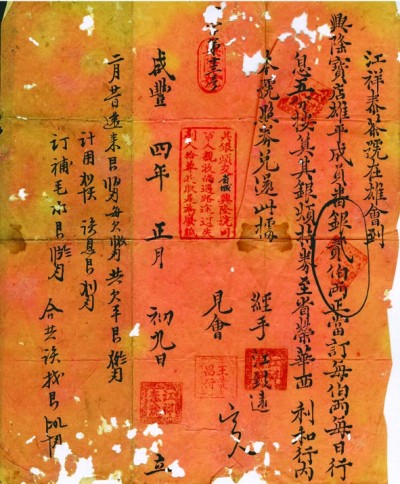
CCTV News:Entering the era of big data, I believe many people have this experience, not the tourist season, but the ticket price is getting higher and higher; When chatting, I casually mentioned a certain product, and when I turned around, I saw the advertising push of related products on major platforms. In the Internet age, we can quickly find the information we want, but the information and data about ourselves seem to be more easily leaked or illegally used by businesses without our knowledge. The following is a case in which consumers are "killed" by big data. 

Not long ago, an article that questioned the use of algorithms by a take-away platform to "kill cooked food" sparked heated discussion. A member user of the platform pointed out that his delivery fee is often higher than that of non-member users for the same order. What was going on at that time? The reporter contacted Mr. Xiao, the author of this article.

Mr. Xiao:"I often order the same takeaway, and suddenly one day I opened a member and found the delivery fee price.Compared with beforeIt has tripled in one fell swoop. It used to be two yuan or free, and then I tried it for almost an hour from 12 noon to 1: 30 pm that day, and the delivery fee was always higher than usual, which was six yuan at that time, and then suddenly caught my attention. "

Mr. Xiao told reporters that in the following week, when ordering takeout, he often used two mobile phones at the same time to log in to member accounts and non-member accounts for comparative experiments, and found that the difference in delivery fees always existed. So he summarized these observations into an article and published it in his personal WeChat official account.

Mr. Xiao:"Later, after my article came out, many netizens left messages in the background and met this kind of member ‘fool friends or acquaintances in business’ The situation. For example, a single item and a mouse, I bought it in 100 yuan when I was not a member, but I bought it with a member.The price became 110 yuan. After I open a member, the price is higher than that of a non-member, so what is the significance of my opening a member? "

After the article sparked a heated discussion, the relevant take-out platform contacted Mr. Xiao. In response to his query, the platform gave the reply that the price difference in delivery fee was an error caused by system cache.

Mr. Xiao:"I have tried many times, and this is the case within a week. That cache statement certainly doesn’t make sense.Where is the location cache? In the same place, the difference is between members and non-members. I consulted some technical friends, and it is true that the error of this cache is within five meters, but it is impossible to cause such a big error. "

Mr. Xiao’s doubts finally failed to get a clear answer. However, his experience has brought the topic of "killing" big data into the public’s field of vision again. So what is behind the "killing" phenomenon of big data?

360-degree accurate portrait The platform collects a lot of personal data.

According to experts, the most critical step in killing big data is to be very familiar with customers, and thus provide differentiated choices. This has already existed in some previous business models, and there are few negative comments.

Pei Wei, Associate Professor, Beihang University School of Law:"As far as big data killing itself is concerned, it is actually differentiated pricing behind it. For example, in insurance, different people may guarantee the amount or amount of money, or the compulsory period of insurance will be different. Therefore, if we simply use differentiated pricing, it does not necessarily constitute a negative thing. What we are disgusted with is differential pricing without a legitimate basis. " 

According to China Consumers Association, consumers are interested in big data.The core of the problem is the application of algorithm technology on the Internet platform, which is embodied in recommendation algorithm, price algorithm, evaluation algorithm, ranking algorithm, probability algorithm and traffic algorithm.

Jian Chen, Director of Complaints Department of China Consumers Association:"For example, when a consumer buys goods or services, the platform will form some personalized recommendations for him according to some browsed pages of the consumer or some preferences of the consumer, including his whereabouts. In fact, the operator may have made some accurate personal data portraits of consumers. According to this portrait, the relevant goods and services are only recommended to him, so his right to know is very flawed. "

How is the Internet platform "familiar" with every user? The answer is through user portraits. Behind the accurate user portrait is a large amount of personal data accumulated by the platform.

Liang Zheng, Vice President of Tsinghua University Institute of Artificial Intelligence International Governance.: "With my data, you finally made such a portrayal of me. Is this accurate? If it is too accurate, people will worry about being manipulated. After a little in-depth discussion, I will find that what I care about is its own discriminatory pricing, or is my information reflected behind it improperly collected and used? "

"APP eavesdropping" technology can be realized, but the cost is high. Low efficiency and high legal risk.

User portraits based on big data can let merchants find out whether you like spicy food or sour food, and rank restaurants that are more in line with your taste through algorithms. User data is often collected by the Internet platform through one mobile APP. In the process of dealing with these APPs, there are also problems that worry everyone, such as the phenomenon of "APP eavesdropping" that we often hear. So does "app eavesdropping" exist?

The APP Governance Working Group consists of a group of cyber security legal and technical experts from the National Information Security Standardization Technical Committee, China Consumers Association, internet society of china and China Cyberspace Security Association.

Technical experts first demonstrated to us whether the APP can eavesdrop technically and what might happen if it eavesdrops through a simulated "APP eavesdropping test program" developed by them.

"We will now enter this test. If we make a speech like this, what happens when the hand is released? The recording actually continues. In fact, we can remove this hint, and the whole process of the test is two minutes. "

Two minutes later, we can see that a 120-second speech was generated in the test program. After the technicians export the voice data, after checking, it is confirmed that "eavesdropping" can be realized when the test program is placed in the foreground.

In addition, after a comparative experiment, the technician told us that the recording can continue for a period of time when the test program is back to the background or the mobile phone is locked, but it will terminate automatically. Just different mobile phone operating systems, the duration of continuous recording under lock screen is slightly different.

Then, is the technically achievable "eavesdropping" method abused in the APP on the market?

Expert of APP Governance Working Group He Yanzhe:"When we actually do this kind of detection of eavesdropping, we found that we haven’t found any APP that has this eavesdropping behavior after uploading voice information."

According to experts from the APP Governance Working Group, although it is technically possible to sneak shots and sneak recordings, this method is costly, inefficient and has high legal risks.

Experts from the APP Governance Working Group said that at present, both the industry standard and the technical level are further strengthening the transparency of calling sensitive rights such as mobile phone microphones, so as to let mobile phone users know.

Expert of APP Governance Working Group He Yanzhe:"Now we see that there are some mobile phone operating systems that have realized real-time prompts for the use of microphones. We call it a recording indicator, which means that when you want to call this microphone, there is a status bar, a red dot or a reminder. "

Accurate platform recommendation is the result of multi-channel aggregation accumulated all the year round.

I just chatted with my friends about the fitness plan, and in a blink of an eye, online shopping platforms began to recommend fitness products to you; Or search for the bottom materials of the overheated pot on a platform, and many platforms have started to recommend the ingredients of the shabu-shabu and even the pots and pans to you frequently. How is such an accurate personalized recommendation achieved?

Expert of APP Governance Working Group He Yanzhe:"An APP, we say that it can make a 360-degree portrait of a user. This portrait, I believe, is the result of years of accumulation, which is the first; Second, it is the result of convergence of multiple channels. "

According to experts, the accuracy of the portrait is mainly achieved through big data analysis of our purchase records, browsing records, search records, and even downloaded application lists.

Expert of APP Governance Working Group He Yanzhe:"Why do you say that sometimes you feel eavesdropped? Providing this source of big data, it is not the current APP, it may be other apps. You have done some operations, it will aggregate the corresponding information together, and it may also associate your friends and people in the same area. Then they have some actions, and it may also become a direction for it to push advertisements. "

Experts suggest that users can find the microphone permission in the permission settings of the mobile phone operating system and check which apps are currently authorized to use the microphone. According to their own needs, users can turn off the authorization to use the microphone for the APP at any time.

More attention should be paid to the illegal collection of personal information by APP.

When the experts of the APP Governance Working Group tested the APP on the market, they also found many problems, such as the long privacy policy, the difficulty for users to understand and the inability to cancel accounts. 

"Let’s give an example. In the process of testing, we found that this wallpaper APP has a privacy policy of more than 10 thousand words. Then let’s see what it says. I believe that no one will finish reading this privacy policy. Even people like us who read privacy policies every day have a headache. For example, this location information written in this privacy policy. The APP said that I want location information. It said a lot of reasons, but I don’t think this reason has anything to do with wallpaper. "

Pei Wei, Associate Professor, Beihang University School of Law: "Whether the privacy policy really serves users or really protects individuals is actually a broken state. Therefore, what is more worrying in the future is the formalization of this protection. "

The APP Governance Working Group has a WeChat WeChat official account platform for "APP Personal Information Reporting" and a dedicated reporting mailbox. Experts told reporters that the difficulty of account cancellation is another problem with a large number of complaints from users at present.

"Take a look at this APP first. There is an account cancellation function. I click to enter my information, and then I find the following sentence is ‘ There is ink balance in the account. Cannot cancel ’ . After I clicked on it, I found that there were 20 virtual coins, which were given by me when I newly registered, and I didn’t buy them myself. I thought, can I use it? It says 49 ink coins. But I only have 20, that is, I have to make up the money, and I will never be able to divide that number. So I can never cancel it. "

Ding Xiaodong, deputy dean of the Institute of Future Rule of Law of Renmin University of China: "From the research of information law, we often have a term called ‘ Digital branding ’ . In this network society, all the footprints are permanently marked. In our country’s personal information protection law, there is a special provision. We say that from the legal rights and interests, it belongs to an individual’s right to delete. "

Pei Wei, Associate Professor, Beihang University School of Law:"The national standard for information technology security, which involves the personal information security specification, specifically mentions this cancellation. That is to say, when you log off or stop using a certain service, its ways and means should be the same as when you use this service. Then at the same time, the information you are required to provide during the logout process should not be more than the information you use and the identity information you provide when using the App. " 

According to experts, the collection of personal information is only one of the links in the circulation of data elements. Protection of personal information security, data storage, processing and circulation also need attention.

Ding Xiaodong, Vice President of the Institute of Future Rule of Law of China Renmin University:"If the front-end link (data collection) is closed, it will actually have a great impact on the development of artificial intelligence and data industry. Then how to reconcile? I think a very important aspect is that after the collection of personal information, it must be managed in a very strict life cycle. We should have an anonymous mechanism and a fuzzy mechanism. When processing, we may have to adopt some principles of data minimization to process the necessary data. In particular, a very high standard should be adopted in the aspects of storage and circulation and the protection of leakage. "

The security boundary needs to be explored by the users of the regulatory platform.

Nowadays, the convenience brought by technology and the protection of personal information are at the two ends of a swinging balance. What role does the law play in the process of "balancing" this balance?

Ding Xiaodong, Vice President of the Institute of Future Rule of Law of China Renmin University:"Our traditional consumer protection law also includes the application of contract law to standard terms, the application of tort law to infringement issues, and many problems in administrative supervision. All these laws can be invoked to a certain extent. But on the other hand, many problems are caused by new technologies such as personal information and algorithms, so to some extent, there are still some shortcomings, and the legislature is actively following up. The entry into force of our civil code may provide a lot of legal support for the protection of personal information. Then the formulation of the Personal Information Protection Law (draft) and the Data Security Law (draft) will certainly provide a lot of additional protection in the future. "

Nowadays, each of us is producing a lot of information. Experts said that in the current social life driven by algorithms and big data, the law plays more of a role of protection. The delineation of security boundaries needs to be explored by regulators, platforms and users in interaction.

Liang Zheng, Vice President of Tsinghua University Institute of Artificial Intelligence International Governance: "From the perspective of laws and regulations, it should be the bottom, and then we draw some red lines, which cannot affect public safety. Even some business models like the digital economy are iterative very quickly, and we can’t wait until the law is enacted. For each problem, there can be corresponding technical solutions to deal with it. It is not unsolvable. The key is that we should make the rules clear. "

Typhoon blue warning! The intensity of Mawa gradually weakened, and there was heavy rain in the northeast of Taiwan Province Island.

  CCTV News:According to the China Weather Network, the Central Meteorological Observatory continued to issue a typhoon blue warning at 06: 00 on May 31: The center of Typhoon Mawar No.2 this year is located at 5: 00 this morning (May 31) in the northwest Pacific Ocean about 455 kilometers southeast of Hualien City, Taiwan Province, China, which is 21.2 degrees north latitude and 124.9 degrees east longitude. The maximum wind force near the center is 12 (35 m/s).

  It is estimated that Mawa will move to the east-north direction at a speed of about 10 kilometers per hour, and its intensity will gradually weaken, and it will approach the southern part of the Ryukyu Islands. It will turn to the northeast from tomorrow (June 1), and its moving speed will gradually accelerate. On the 5 th, it will be transformed into an extratropical cyclone in the east of Japan.

  Gale forecast: From 08: 00 on May 31st to 08: 00 on June 1st, there will be 6-8 winds in the east of Taiwan Province, bashi channel, Taiwan Province Strait, the northeastern part of South China Sea, the southern part of East China Sea and the waters near Diaoyu Island, the eastern and northern coasts of Taiwan Province Island, and the coastal areas of Fujian. Among them, the winds in the east of Taiwan Province can reach 9-10, and the gusts are 11-12. The winds in the nearby sea passing by Mawa Center can reach 11. There is a southwesterly wind with 5-6 grades and a gust of 7 grades in the southern South China Sea.

  Precipitation forecast: From 08: 00 on May 31st to 08: 00 on June 1st, there will be heavy rain or rainstorm in some parts of northeast Taiwan Province Island, and there will be heavy rain (100-120mm) in some parts.

qxtx

qxtx

qxtx

  Defense guide:

  1. The government and relevant departments shall, in accordance with their duties, do a good job in typhoon prevention and emergency rescue.

  2. Water operations and passing ships in relevant waters should return to Hong Kong to take shelter from the wind, strengthen port facilities, and prevent ships from anchoring, grounding and collision.

  3. Stop large-scale indoor and outdoor gatherings and dangerous outdoor operations such as high altitude.

  4. Reinforce or dismantle structures that are easy to be blown by the wind. Personnel should not go out at will. They should stay in windproof and safe places as far as possible, so as to ensure that the elderly and children stay in the safest place at home, and the dangerous people will be transferred in time. When the typhoon center passes by, the wind will decrease or stay still for a period of time. Remember that the strong wind will suddenly blow, and you should continue to stay in a safe place to avoid the wind, and the dangerous people will be transferred in time.

  5. Relevant areas should pay attention to prevent flash floods and geological disasters that may be caused by heavy precipitation.