On clarifying the limitation of action | litigation help
Shanghai Minhang court helped by original lawsuit.
Litigation help

The limitation of action system means that if the subject of rights fails to take legal action to safeguard his rights within a specific period stipulated by law, his right to request judicial relief will be extinguished. In short, the system aims to urge the subjects of rights to actively exercise their rights, so as to avoid that the rights cannot be realized through judicial channels due to slackness. Although the right itself has not been extinguished by the completion of the limitation, the obligee will lose the legal qualification to obtain a successful judgment through litigation.
First, the limitation period of ordinary litigation
According to Article 188 of the Civil Code of People’s Republic of China (PRC), the limitation period of ordinary litigation is three years, counting from the day when the obligee knows or should know that the right has been damaged and the obligor.
Second, the limitation period of special litigation
The law also provides for a special statute of limitations:
● The limitation of action for bringing a lawsuit or applying for arbitration due to disputes over international contracts for the sale of goods and technology import and export contracts is four years;
● The limitation period for the claim for compensation from the carrier in the carriage of goods by sea is one year, and for the claim for compensation from a third party by the person deemed responsible, the limitation period is 90 days, and for the claim for voyage charter party, the limitation period is two years;
● The limitation period for claiming compensation from the carrier for the carriage of passengers by sea is two years;
● The limitation period for claims related to ship charter contracts is two years;
● The limitation period for claims related to towage contracts at sea is one year;
● The limitation period for claims related to ship collision is two years; The limitation period for the right of claim for recovery stipulated in the third paragraph of Article 169 of the Civil Code of People’s Republic of China (PRC) is one year;
● The limitation period for claims related to salvage at sea is two years;
● The limitation period for claims related to general average contribution is one year;
● The limitation period for claiming insurance compensation from the insurer according to the marine insurance contract is two years;
● The limitation period for claims for oil pollution damage to ships is three years.
Swipe up to read
Maritime Code of People’s Republic of China (PRC)
Article 257 The limitation period for claiming compensation from the carrier for the carriage of goods by sea is one year, counting from the date when the carrier delivered or should have delivered the goods; If, within the limitation period or after the expiration of the limitation period, the person deemed to be responsible files a claim for compensation with a third party, the limitation period shall be 90 days, counting from the date when the claimant solves the original claim for compensation or receives a copy of the complaint filed by the court that accepted the lawsuit against him.
The limitation period for claims related to voyage chartering contracts is two years, counting from the day when you know or should know that your rights have been infringed.
Article 258 The limitation period for claiming compensation from the carrier for the carriage of passengers by sea is two years, which shall be calculated in accordance with the following provisions:
(1) The claim for personal injury of passengers shall be counted from the day when the passengers disembark or should disembark;
(2) If the claim for the death of the passenger occurred during the period of transportation, it shall be counted from the date when the passenger should leave the ship; If the passenger dies after disembarking due to injury during the transportation period, it shall be counted from the date of the passenger’s death, but this period shall not exceed three years from the date of disembarkation;
(3) The claim for loss of or damage to luggage shall be counted from the day when the passenger disembarked or should disembark.
Article 259 The limitation period for claims relating to ship chartering contracts is two years, counting from the day when you know or should know that your rights have been infringed.
Article 260 The limitation period for claims relating to a contract of towage by sea is one year, counting from the day when you know or should know that your rights have been infringed.
Article 261 The limitation period for claims related to ship collision is two years, counting from the date of the collision accident; The limitation period for the right of claim for recovery stipulated in the third paragraph of Article 169 of this Law is one year, counting from the date when the parties jointly pay damages.
Article 262 The limitation period for claims for salvage at sea is two years, counting from the date of termination of salvage operations.
Article 263 The limitation period for claims for contribution in general average is one year, counting from the date when the self-care calculation ends.
Article 264 The limitation period for claiming insurance compensation from the insurer under the marine insurance contract is two years, counting from the date of the insured accident.
Article 265 The limitation period for claims for oil pollution damage to ships is three years, counting from the date of the damage; However, in no case shall the limitation period exceed six years from the date of the accident that caused the damage.
● The limitation period for the insured or beneficiary of insurance other than life insurance to claim compensation or pay insurance benefits from the insurer is two years, and the limitation period for the insured or beneficiary of life insurance to ask for payment of insurance benefits from the insurer is five years;
● The limitation period for claiming damages due to product defects is two years.
Swipe up to read
Insurance Law of People’s Republic of China (PRC)
Article 26 The limitation of action for the insured or beneficiary of insurance other than life insurance to claim compensation or pay insurance money from the insurer is two years, counting from the day when he knows or should know the occurrence of the insured accident.
The limitation of action for the insured or beneficiary of life insurance to ask the insurer to pay the insurance money is five years, counting from the day when he knows or should know that the insurance accident happened.
People’s Republic of China (PRC) Product Quality Law
Article 45 The limitation period for claiming damages due to product defects is two years, counting from the time when the parties know or should know that their rights and interests have been damaged.
The right to claim compensation for damage caused by defective products shall be lost ten years after the defective products that caused the damage were delivered to the original consumers; However, it is not beyond the express safe use period.
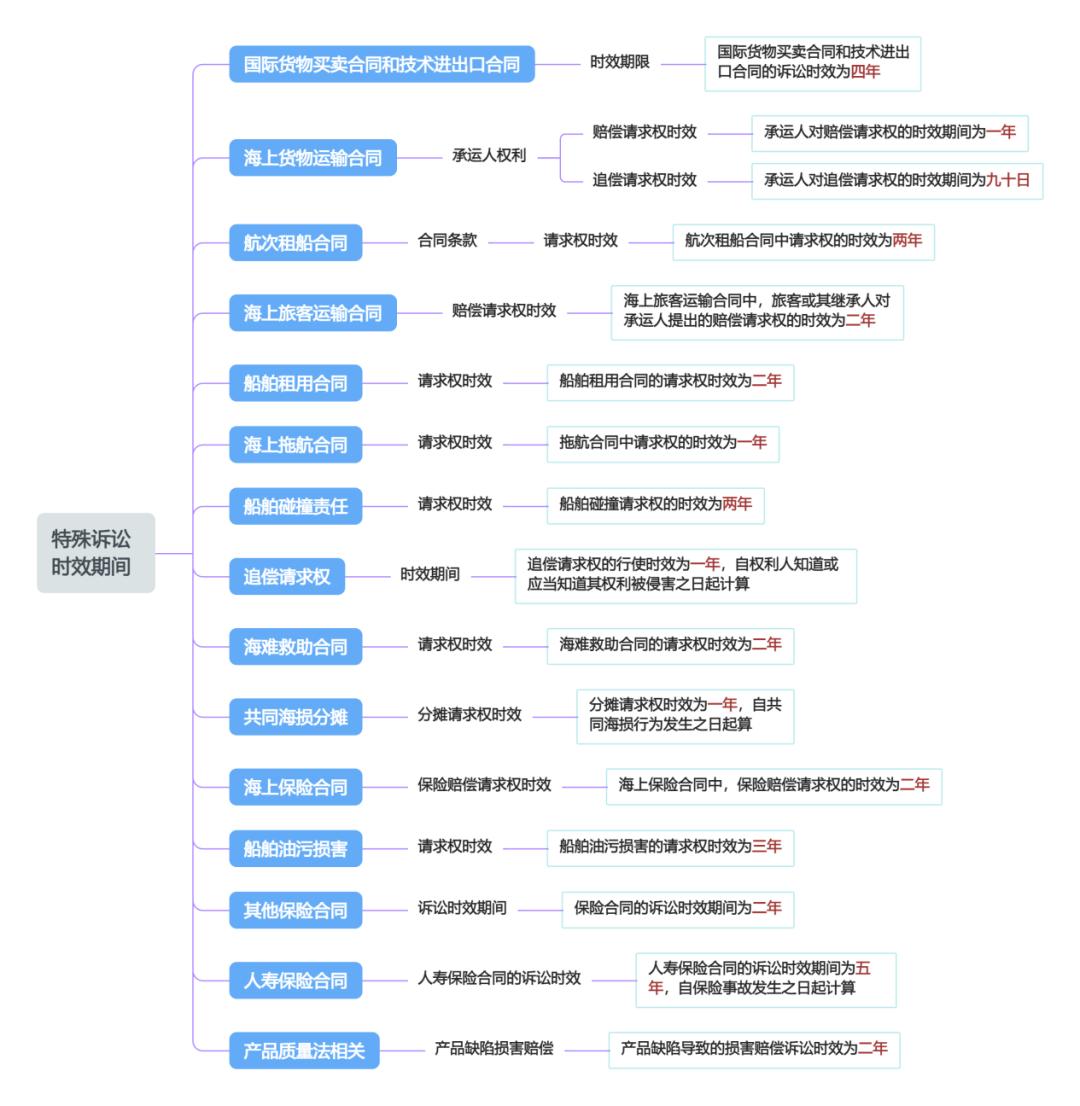
Illustration of limitation period of special action
Third, the longest statute of limitations
The longest limitation period of action is the longest period during which the obligee can claim his rights. According to Article 188 of the Civil Code of People’s Republic of China (PRC), the longest limitation period of action is 20 years, unless in special circumstances, the people’s court may extend it upon the application of the obligee. If more than 20 years have passed since the date of the damage, and the general limitation period expires, the obligee will lose the right to win the lawsuit. However, under certain circumstances, the limitation of action may be shorter than 20 years. For example, Article 265 of People’s Republic of China (PRC) Maritime Code clearly states that the longest limitation of action involving the claim for compensation for oil pollution damage from ships shall not exceed six years from the date of the damage accident under any circumstances. In addition, Article 45 of the Product Quality Law of People’s Republic of China (PRC) also stipulates that the right to claim compensation for damage caused by product defects shall be lost ten years after the defective products are delivered to the original consumers; Unless the product has not exceeded its express safe use period.
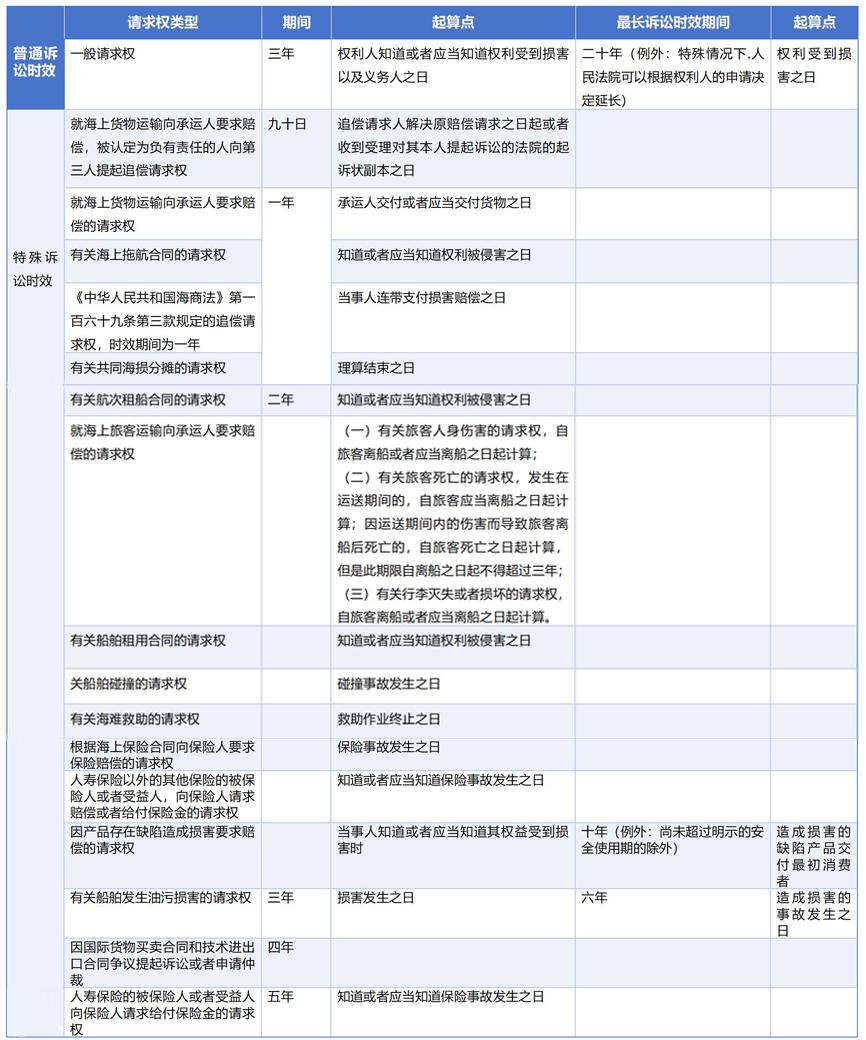
Diagram of the longest limitation of action
Fourth, the scope of application of the statute of limitations
First, only the right of claim is subject to the statute of limitations
The right of claim refers to the right of a specific person to ask a specific person to do or not do a specific act based on certain basic rights. The subject of rights and obligations are specific, and the right of claim is relative in principle.
It should be noted that the limitation of action does not apply to the right to claim control, but according to Article 196 of the Civil Code of People’s Republic of China (PRC), the limitation of action applies to the right holder who requests to return the property based on the unregistered movable property right (the right to claim the original property).
Tips
In principle, all claims for creditor’s rights are subject to the limitation of action, but Article 196 of the Civil Code of People’s Republic of China (PRC), Article 1 of the Provisions of the Supreme People’s Court on Several Issues Concerning the Application of the Limitation of Action System in the Trial of Civil Cases and the Supreme People’s Court’s Application
Provisions on Several Issues of People’s Republic of China (PRC) Company Law (III) Article 19 stipulates that the following types of claims for creditor’s rights are not subject to the statute of limitations:
1. The obligee of immovable property right and registered movable property right requests to return the property;
2. Request to pay alimony, alimony or alimony;
3. Claim for payment of deposit principal and interest;
4. The right to claim the principal and interest of treasury bonds, financial bonds and corporate bonds issued to unspecified objects;
5. Claims for capital contribution arising from investment relationship;
6. The company or other shareholders request the shareholders with defective capital contribution to fully fulfill their capital contribution obligations or return the creditor’s rights of capital contribution to the company;
7. The creditor’s rights of the company requesting the shareholders who have not fulfilled or fully fulfilled their capital contribution obligations (shareholders with defective capital contribution) to bear supplementary compensation liability for the part of the company’s debts that cannot be paid off within the scope of unfunded principal and interest;
8. The creditor’s rights of the company requesting the shareholders who withdraw their capital contribution to bear supplementary liability for the unpaid part of the company’s debts within the scope of withdrawing their capital contribution principal and interest.
As for the nature of "requesting to stop the infringement, removing the obstruction and eliminating the danger" in the first paragraph of Article 196 of the Civil Code of People’s Republic of China (PRC), combined with the provisions of Article 236 of the Property Rights of the Civil Code of People’s Republic of China (PRC) (Article 236 impairs or may impair the property rights, The obligee may request to remove the obstruction or eliminate the danger) and Article 167 of Tort Liability of People’s Republic of China (PRC) Civil Code (Article 167, if the infringement endangers the personal and property safety of others, the infringed has the right to request the infringer to undertake the tort liability such as stopping the infringement, removing the obstruction and eliminating the danger). The nature of the right to stop the infringement here should be the right to claim the tort debt. To eliminate the obstruction and danger, it should be defined as the claim of real right and the claim of tort debt according to the provisions of Article 236 of the real right series or Article 167 of the tort liability series, but no matter what the nature, the statute of limitations is not applicable according to the provisions of Article 196 of the Civil Code of People’s Republic of China (PRC).
In addition, according to the 14th batch of guiding cases issued by the Supreme People’s Court:
Five cases (Guiding CasesNo. 65-69), including the case of owners’ meeting of Jiule Building Community in Hongkou District of Shanghai v. Shanghai Huanya Industrial Corporation.
Referee points:
Special maintenance funds are used for the maintenance, renewal and transformation of shared parts and shared facilities and equipment after the warranty period expires, and belong to all owners. Paying special maintenance funds is a legal obligation for owners to maintain the long-term safe use of buildings. If the owner refuses to pay the special maintenance fund and raises a defense with the limitation of action, the people’s court will not support it.
Therefore, the limitation of action does not apply to the owners’ right to request the owners to pay special maintenance funds.
Second, the limitation of action does not apply to the right of personality and the right of identity.
Swipe up to read
Civil Code of People’s Republic of China (PRC)
Article 196 The limitation of action shall not apply to the following claims:
(a) request to stop the infringement, remove obstacles and eliminate dangers;
(2) The obligee of immovable property right and registered movable property right requests to return the property;
(3) Requesting to pay alimony, alimony or alimony;
(four) other claims that are not applicable to the limitation of action according to law.
Article 236 Where the property right is impaired or may be impaired, the obligee may request that the obstruction or danger be eliminated.
Article 995 Where the right of personality is infringed, the victim has the right to request the actor to bear civil liability in accordance with the provisions of this Law and other laws. The limitation of action does not apply to the victim’s right to stop the infringement, remove the obstruction, eliminate the danger, eliminate the influence, restore his reputation and apologize.
Article 101 The protection of the identity rights of natural persons arising from marriage and family relations shall be governed by the relevant provisions of Parts I and V of this Law and other laws; If there are no provisions, the relevant provisions on the protection of personality rights in this part can be applied according to their nature.
Article 167 Where an infringement endangers the personal and property safety of others, the infringed party has the right to request the infringer to bear the tort liability of stopping the infringement, removing the obstruction and eliminating the danger.
Three, the right of domination, the right of defense and the right of formation are not applicable to the statute of limitations.
Domination refers to the right of the obligee to directly control the object of rights, enjoy specific interests and exclude others’ interference, such as property right, personality right, identity right, intellectual property right, network virtual property, etc. The reason why the limitation of action does not apply to domination is because the existence of domination itself is the purpose of existence, and the realization of rights is direct, which can be realized only by the will of the obligee, without the obligor’s active behavior, but only by asking others to do nothing.
The right of defense is a defensive right, which can only achieve the purpose of refusing to pay when the obligee requests. Its function is to hinder the realization of the right of claim, and the right of defense has the characteristics of permanence.
The right of formation is the right to change an existing legal relationship according to the unilateral will of the obligee without the participation of others. For example, the right of claim for the division of co-ownership stipulated in Article 303 of the Civil Code of People’s Republic of China (PRC), the preemptive right of co-owners by shares stipulated in Article 305, the right of ratification in contracts with pending validity stipulated in Articles 145 and 171 and the cancellation right of bona fide counterpart in contracts with pending validity, the cancellation right of revocable legal acts stipulated in Article 152, and the choice right of debt of choice stipulated in Article 515. The statutory right of set-off stipulated in Article 568, the statutory right of rescission and the agreed right of rescission stipulated in Articles 562 and 563, the buyer’s approval right in the trial sales contract stipulated in Article 638, the lessee’s preemptive right in the house lease contract stipulated in Article 726, and the third party’s option in the indirect agency stipulated in Article 926. The revocation right in revocable marriage stipulated in Articles 1052 and 1053, the right to divorce in Article 1079, the right to dissolve the adoption relationship in Articles 114 and 115 of the Civil Code, the right to withdraw and change the will in Article 142, and the right to divide the estate.
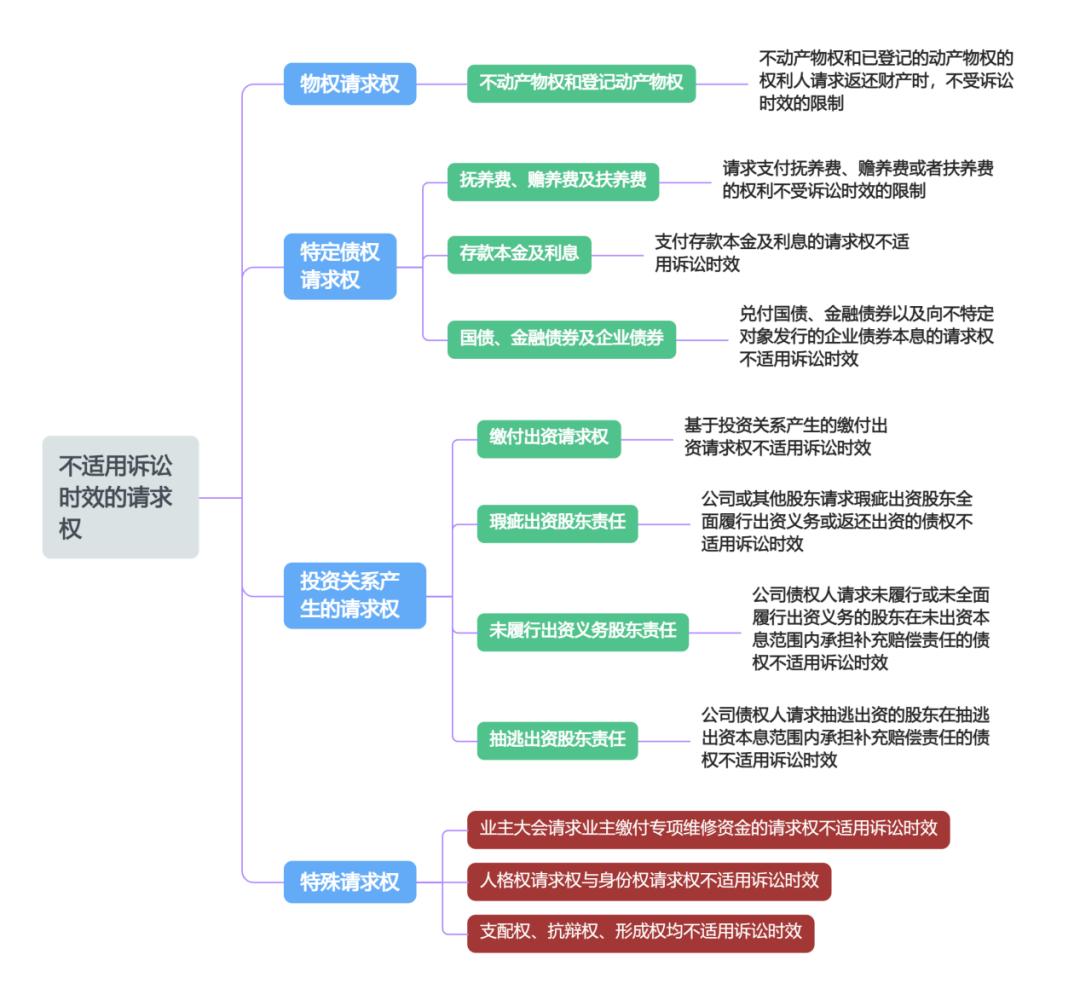
Illustration of claim right without limitation of action
V. Interruption and suspension of limitation of action
The interruption and suspension of the calculation of the limitation of action refers to the legal system in which the limitation of action is recalculated due to the occurrence of specific reasons. Specifically, the interruption of the limitation of action means that during the limitation of action, due to the emergence of legal reasons such as the obligee filing a lawsuit and the debtor acknowledging the debt, the limitation period that has been carried out is invalid and the limitation of action is calculated again. The suspension of the limitation of action refers to the temporary suspension of the calculation of the limitation period due to force majeure or other legal reasons during the limitation of action, and the calculation will continue after the cause is eliminated. These two systems are designed to protect the legitimate rights and interests of obligees and prevent obligees from losing their litigation rights due to the lapse of the limitation period.
Tips
One, the following circumstances should be regarded as "the obligee puts forward a request for performance to the obligor" referred to in Article 195 of the Civil Code of People’s Republic of China (PRC), which leads to the interruption of the limitation of action:
1. The parties directly send the documents claiming rights to the other party, and the other party signs, seals, fingerprints or otherwise proves that the documents have been delivered (if the other party is a legal person or other organization, the signatory may be its legal representative, principal responsible person, department responsible for sending and receiving letters or authorized subject; If the other party is a natural person, the signatory can be the natural person himself, a relative with full capacity living together or an authorized subject. When the obligee claims the same part of the creditor’s rights, the interruption effect of the limitation of action extends to the remaining creditor’s rights, unless the obligee explicitly waives the remaining creditor’s rights. If the parties submit a complaint or oral prosecution to the court, the limitation of action shall be interrupted from the date of prosecution);
2. The parties claim their rights by letter or data message, and the letter or data message has arrived or should have arrived at the other party;
3. The parties are financial institutions, and the principal and interest of arrears are deducted from the other party’s account according to law or agreement;
4. The whereabouts of the parties are unknown, and the other party publishes a notice of claiming rights in influential media at the national or provincial level, unless there are special provisions in laws and judicial interpretations.
Two, the right subject to the people’s mediation committee or other state organs, institutions and social organizations with the function of solving civil disputes, the limitation of action shall be interrupted from the date of the request. When the right subject reports or complains to the public security organ, the people’s procuratorate or the people’s court to request the protection of civil rights, the limitation of action shall be interrupted from the date of reporting or complaining. If the above-mentioned authorities make a decision not to file a case, dismiss the case or prosecute, the limitation of action will be recalculated from the date when the right subject knows or should know; If a criminal case enters the trial stage, the limitation of action will be recalculated from the date when the criminal judgment document takes effect.
Three, the following matters shall be deemed to have the same effect of interruption of the statute of limitations as bringing a lawsuit:
1. Apply for a payment order;
2. Apply for bankruptcy and declare bankruptcy claims;
3. Apply for declaring the obligor missing or dead;
4. Apply for pre-litigation property preservation, pre-litigation temporary injunction and other measures;
5. Apply for enforcement;
6. Apply for additional parties or be notified to participate in litigation;
7. Advocating set-off in litigation;
8. Other matters with the same effect of interruption of limitation of action, etc.
Swipe up to read
Civil Code of People’s Republic of China (PRC)
Article 195 If the limitation of action is interrupted in any of the following circumstances, the limitation of action shall be recalculated from the time when the interruption and relevant procedures are terminated:
(1) The obligee makes a request for performance to the obligor;
(2) The obligor agrees to perform the obligation;
(3) The obligee brings a lawsuit or applies for arbitration;
(4) Other circumstances that have the same effect as bringing a lawsuit or applying for arbitration.
● In the case of "the obligor agrees to perform the obligation" stipulated in Article 195 of the Civil Code of People’s Republic of China (PRC), if the obligor makes commitments or acts such as performing by stages, partially performing, providing guarantee, requesting to postpone performance or making a debt repayment plan, it shall be deemed that the limitation of action has been interrupted.
● When one of the joint and several creditors has the cause of interruption of limitation of action, the interruption effect also extends to other joint and several creditors. Similarly, when one of the joint debtors has a cause of interruption of limitation of action, the interruption effect also extends to other joint debtors.
● In the case that the creditor brings a suit of subrogation, the interruption effect of the limitation of action will affect the calculation of the limitation of action of both the creditor and the debtor.
● When the creditor’s rights are transferred, the limitation of action is interrupted from the date when the notice of creditor’s rights transfer reaches the debtor.
● In the case of debt assumption, if it constitutes the original debtor’s acknowledgement of the debt, the limitation of action will be interrupted from the date when the intention of debt assumption reaches the creditor.
● When the limitation of action of the principal debt expires, the guarantor will enjoy the defense right of the limitation of action of the principal debtor. If the guarantor assumes the guarantee responsibility without claiming the right of defense of limitation of action mentioned above and exercises the right of recourse against the principal debtor, the people’s court will not support it unless the principal debtor agrees to pay.
● After the expiration of the limitation period of action, if the parties give their consent to perform their obligations to the other party or voluntarily perform their obligations, and then make a defense on the grounds of the expiration of the limitation period of action, the people’s court will not support it. If the parties reach a new agreement on the original debt, the creditor claims that the obligor waives the right of defense of limitation of action, and the people’s court should support it.
● After the limitation of action expires, if the lender issues a notice to the borrower to call for the loan due, and the debtor signs or seals the notice, it can be concluded that the borrower agrees to perform the obligation that the limitation of action has expired. The people’s court should support the lender’s claim that the borrower waives the right of defense of the limitation of action.
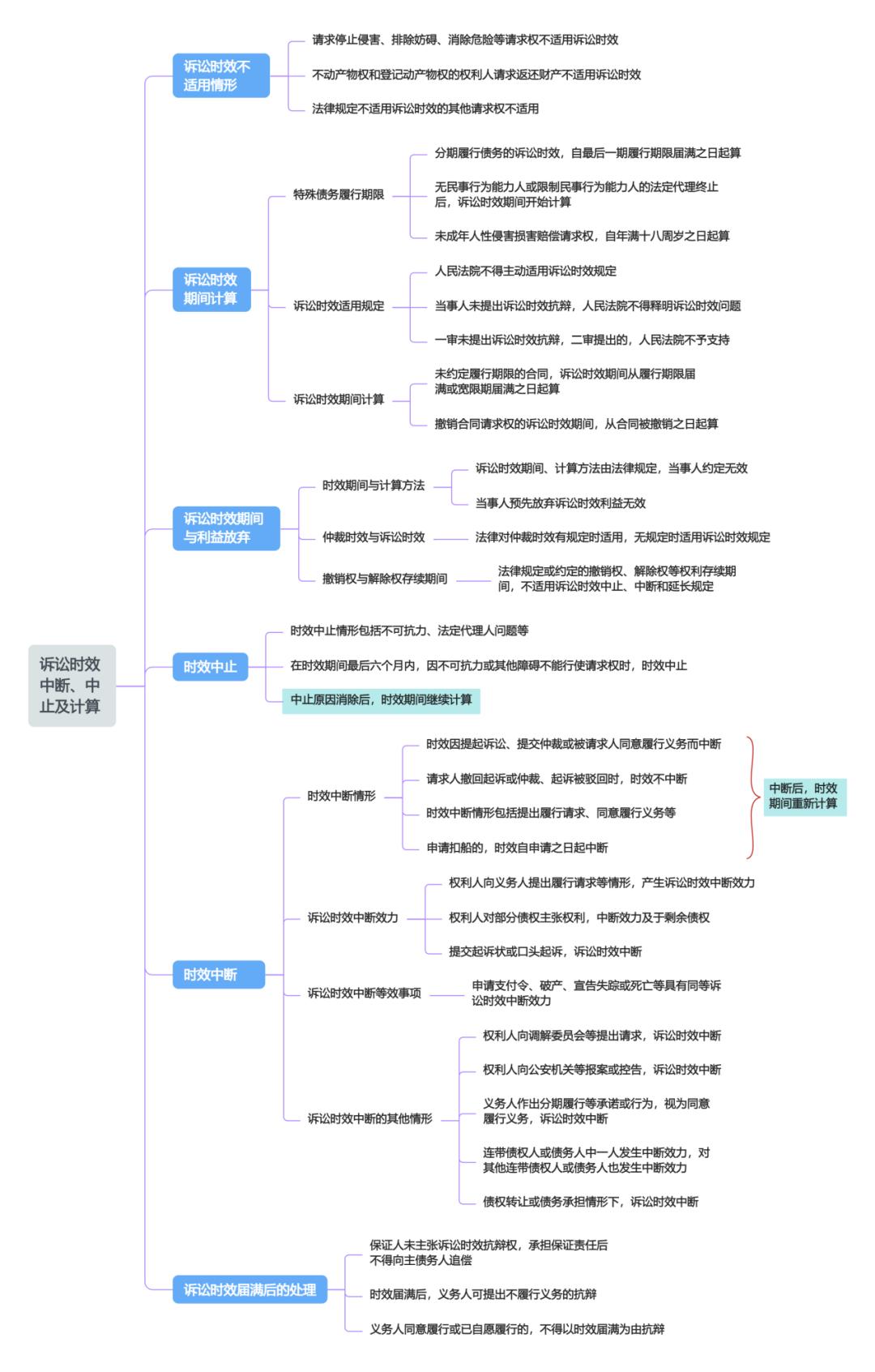
Interruption, suspension and calculation diagram of limitation of action

Source: Duan Wenlan, Wei Sijie, Civil Court
Original title: "One article clarifies the limitation of action | litigation help"