Wang Zhenzhong: The only Chinese mentioned in Das Kapital
Shexian Guild Hall in Beijing in the Qing Dynasty was located in Xuanwumenwai Street, where Beijing official Wang Maoyin (No.Zihuai, 1798-1865) once lived. Wang’s official residence in the imperial history made him famous for daring to speak, and later he was promoted to the right assistant minister of the household department. At that time, Su Shun, the powerful minister, was in power, and he was quite afraid of Wang Maoyin, who had a clean name, so he tried to send someone to pull the cage. In this regard, Wang Maoyin was also quite moved at the moment and made an appointment to pay his respects on a certain day. On the appointed day, the middleman arrived early and sat outside the hall waiting to go with him. Wang also had horses and chariots prepared, and he came out wearing a hat. At that time, there was a big mirror in the east of the hall. When Wang Maoyin passed by, he couldn’t help looking at himself up and down carefully. I saw that he had to say to himself, "How can you be a prince?" Then he immediately went back to his bed, excused himself from being ill and sent the lobbyist away …
The above-mentioned plot comes from "Clear Barnyard Notes" compiled by Xu Ke in the Republic of China. The book "Qing’s Banknotes" is full of anecdotes and anecdotes, and many of its contents are quite vivid, but its story source is usually difficult to trace. However, the story of "Wang Maoyin is not in Su Shun" can also be found in "Talking about Things" compiled by Xu Chengyao, a Huizhou historian in Beijing. Xu Shi, a disciple of Wang Zongyi, Wang Maoyin’s son-in-law, made a detailed investigation of the historical sites of Shexian Guild Hall in Beijing. It is said that in the late Qing Dynasty and the Republic of China, when people living in the capital of overseas Chinese mentioned Wang Maoyin, they always pointed to the mirror in the hall and told the above story.
According to the historical facts, in the early years of Xianfeng, Su Shun, the Manchu power minister, was deeply trusted by the emperor. He rebelled against the old rules of his ancestors who "paid more attention to the Han people than to the Han people" and tried his best to convey it to the Han scholar-officials. Therefore, this story may not be an unfounded fiction. However, through this story, people can see a more important point-regardless of the merits and demerits of historical figures, people act in the world, the temptation of fame and fortune, the balance of gains and losses, and the evaluation of fame behind them are sometimes only in a moment. Only when the person concerned looks at himself in the mirror can he best see the secrets in his heart; As historical spectators, the information provided by handed down literature to us bystanders is really quite limited.

Statue of Wang Maoyin in Shexian County
Wang Maoyin is the only Chinese mentioned by Marx in Das Kapital. This person is a native of Shexian County, Huizhou Prefecture. In 1853, he became the right assistant minister of the Ministry of Housing and was also in charge of the affairs of Qianfatang. He was opposed to casting large sums of money, thinking that low-value copper coins would inevitably lead to rising prices, but this suggestion was not adopted by the emperor. In April of the following year, Wang Maoyin once again talked about the banknote law, requesting that the issued non-convertible banknotes be changed into convertible banknotes, and stipulating the maximum amount of issuance, which is conducive to the development of business and the operation of the economy. As a result, he was reprimanded by Emperor Xianfeng as being instructed by businessmen and not caring about state affairs.
Later, Marx learned Wang Maoyin’s proposition from the investigation report of the Russian Embassy in Beijing, and regarded it as a "new material" of monetary theory and history, which was mentioned in the footnote of Volume 1 of Das Kapital:
Wang Maoyin, the right assistant minister of the Qing dynasty, made a memorial to the emperor, advocating secretly changing official tickets and treasure banknotes into cashed banknotes. In the minister’s deliberation report in April 1854, he was severely reprimanded. Whether he was flogged for this is unknown. At the end of the deliberation report, it said: "It is not convenient for China to read the patent dealers in detail."
Because of the mention of Das Kapital, Wang Maoyin’s monetary thought has been concerned by academic circles for more than 80 years since the 1930s, and famous scholars such as Guo Moruo and Wu Han have expressed their opinions on it. However, in the past, the most systematic document on which people based their arguments was the red tape article "Wang Shilang’s Memorial", with little private information, so that we knew little about Wang Maoyin’s life world outside the temple. In view of this, this paper makes use of the newly discovered Correspondence of Ji Yue Xuan to study the daily life of the Huizhou Jing Guan during the period of Xianfeng’s war, hoping to reveal more about Wang’s family background and social contacts through these manuscripts, and to understand the origin of his "monetary thought" from some aspects.

Transcript of Ji Yuexuan’s Correspondence Book Shadow
Brief introduction of Wang Maoyin’s personal letter
One copy of Ji Yuexuan’s Correspondence is a related manuscript of Wang Maoyin from 1855 to 1859. This manuscript belongs to the "letter base" in Huizhou documents. The so-called letter base is a manuscript or transcript formed by copying letters sent by individuals or letters exchanged with each other into a book.
In the traditional era, people have different purposes to trust each other. Generally speaking, businessmen do this out of the need of business operation, mainly for memo, so as to read, refer to and check the accounts when necessary. Scholars, on the other hand, use this to accumulate personal data, and prepare materials for compiling family instructions, last words and even forming a collection of works in the future. As a famous bureaucrat in the same period of Xian, some words in Ji Yue Xuan’s Correspondence were widely circulated.
Because some letters are presented in the form of family instructions and last words, it is not excluded that the author has considered them when writing and copying. Under the immortal self-expectation or psychological suggestion, when writing, people tend to sit still and be dignified, or polish it after copying the final version. However, judging from the letters received in Ji Yue Xuan’s Correspondence, many of them are related to the privacy of family background, which should belong to a relatively primitive "letter base".
In addition, the name of this copy is related to the place where Wang Maoyin lived in Beijing at that time. It is speculated that Wang Maoyin may once live in the Sleeping Buddha Temple in the Western Hills of Beijing, and "Jiyuexuan" is a courtyard in the Sleeping Buddha Temple, so "Jiyuexuan Correspondence" should be the correspondence between Wang Maoyin and Ji Yuexuan during his residence in the Sleeping Buddha Temple from 1855 to 1859.
Daily life of Beijing official Wang Maoyin during the Taiping Heavenly Kingdom.
The 82 correspondence included in Ji Yue Xuan’s Correspondence is the correspondence between Wang Maoyin, his brothers, sons and others with relatives and friends, which covers a wide range of contents. Besides state affairs and family chores, more letters reflect some aspects of Wang Maoyin and his family’s daily life in Beijing during Xianfeng years, which are discussed below.
Donate officials on behalf of others
In order to solve the financial problems, the Ming and Qing governments carried out the donation system and sold various qualifications related to being an official. The most frequent letters in Ji Yue Xuan’s Correspondence are about donating officials.
For example, the fifth letter in the codex is a letter from Qianqiu Guan Dushou and Manchu Alinbao. He said that his son Baoyin wanted to add a donation to the post of judge, and designated it to be distributed to Shandong Province as an alternate. He hoped that Wang Maoyin’s younger brother Wang Mao Ai would donate money for him, and promised that once he got the license, he would return it in all quarters. In the Qing Dynasty, donors would borrow money from Shanxi Bank or other financial institutions in Beijing (such as banks and banks) if they didn’t have enough funds to donate. However, for Alinbao’s request, Wang Mao replied very politely: He buys goods and sends them to Beijing every year, and sends the silver back to Huizhou home after selling them. However, in recent years, due to the poor traffic between the north and the south, the business is sparse, and there is no goods sent to Beijing at home, and Beijing has no silver coins to send back to Huizhou. Therefore, Alinbao’s request to accommodate the silver coins and donate official positions on his behalf is really at a loss. In addition, at that time, the price of silver in Beijing fluctuated, and Jiangnan and Beijing were separated by thousands of miles. It took dozens of days for letters to exchange, and there was no way to communicate with each other at any time, so it was even more difficult to deal with. Judging from the contents of the above two letters, Wang Mao Ai transports tea, Four Treasures of the Study and other local products from his hometown to Beijing through long-distance trafficking every year, and then sells them and returns them to his home. In addition, judging from the basic situation of Beijing’s agency donation at that time, agencies and individuals usually provide money for donors, so Alinbao will make the above request. From this point of view, as the younger brother of Beijing official Wang Maoyin, Wang Mao Ai is indeed a professional businessman who reports donations on behalf of others. Just because he may have limited money,So I refused Alinbao’s request. Of course, it is more likely that the other party is a Manchu, and doing this deal for it will have certain risks.
Regarding the donation of officials, the 13th letter included in Ji Yuexuan’s Correspondence was written by Wang Maoyin from Beijing to his relative Wang Erchang in 1857. The letter mentioned the advantages and disadvantages of the officials donated at that time, the fierce competition for alternate officials, and enlightened the price of donating officials. He earnestly warned that once he was ready to be an official, the ups and downs of his official career were often involuntary and he had to take care of himself. Regarding Wang Erchang’s official donation, the 29th letter of Ji Yuexuan’s Correspondence was written to Wang Maoyin by Wang in Beijing in 1858, in which he mentioned that he had collected 1,500 taels and planned to remit money to Beijing through Wang Yongyi’s silk shop in shengze town. In this regard, Wang Maoyin’s reply from Beijing (the 30th letter) not only talked about the specific situation of donating officials, but also pointed out: as long as you have silver on hand, you don’t have to worry about not being able to remit money to Beijing. This clearly shows that in the 1950s, even during the war, the exchange between Huizhou and Beijing was still quite smooth.
Regarding donation and exchange, the 21st letter was written by Bao Enqi to Wang Ming, the eldest son of Wang Maoyin, in 1857. It was mentioned in the letter that Wang Maoyin had donated a real job for Bao Enqi’s friend, and after it was completed, a letter from Jixi sent 624 Liang. Among them, 600 taels is the money actually spent for donation, while 24 taels is one cent per month, with a total of four months’ interest. It can be seen that Wang Maoyin and his family have also obtained relevant benefits by donating officials on behalf of others. Since then, the 22nd letter should be a letter sent by Wang Ming to an elder named "Yunyou", in which he mentioned that he had received the silver coins brought by a letter from Jixi. Later, he will send a letter to inform Wang Maoyin who is far away in Beijing. All these show that Wang Maoyin donated official positions for people in the capital, while his home in Shexian received silver from the official donors.
In addition to donating officials from fellow villagers, there are also many donors among Wang Maoyin’s closest relatives. The 36th letter was written by Wang Maoyin to the eldest son-in-law Hong Chengji. In the letter, Wang Maoyin first stated that he did not approve of Hong Chengji’s donation of officials. He believes that there are two realms of being an official, one is to be a good official for the country and the people, and the other is to be an official only for personal gain. In his view, being an official should be for the country and the people, not just for personal gain. Having said these truths, Wang Maoyin then made a concrete analysis of the actual situation of Hong Chengji. He thought that Hong had no children at that time, so he was sure to bring his family to Beijing. Being a Beijing official was obviously quite unfavorable, and if he donated foreign officials, there would be great problems. At that time, the candidates who went to the "safe province" (that is, those provinces where there was no war) were overcrowded, and it took a long time to get the official vacancy. In this case, every year in the provincial capital, food and related entertainment must be supplemented and compensated by their own homes. However, if you go to "military affairs to save points", although it is easier to get the job vacancy, it is quite dangerous, sometimes it will make people in a dilemma, or they will lose their lives or be blamed by the court. At that time, Hong Chengji owned stores in other places, while he owned land in his hometown, which was a typical home of Huizhou merchants. In view of this, Wang Maoyin believes that the eldest son-in-law is a well-off family. Unlike those officialdom speculators who "live in debt and die in debt", it is completely unnecessary to take risks by donating officials.
In addition to the eldest son-in-law, Wang Maoyin’s cousin Hongliangcai also has the willingness to donate. The 37th letter of Ji Yuexuan’s Correspondence is a letter he wrote to Hong Liangcai from Beijing. The annex to the letter mentioned the donation entrusted by this cousin. At that time, Hong Liangcai and others remitted the money to Jingshi 50 Liang through Wan Feng Store. In this regard, Wang Maoyin explained the detailed expenses of the fee. This example also shows that the donated expenses are also transferred through the exchange between Beijing and Jiangnan.
In Ji Yuexuan’s Correspondence, there is not only a special list of the price of donating officials, but also discussions in this regard can often be seen in various letters. It can be seen that Wang Maoyin has a very clear understanding of donation and related money price comparison.

Letters on Donation in Ji Yue Xuan’s Correspondence
Request for assistance in litigation
China is a personal society, and in Huizhou, which attaches great importance to nostalgia and clan friendship, Wang Maoyin, as a second-class Beijing official, is inevitably entrusted by people to work for relatives and friends.
Take Wang Maoyin’s closest relative as an example. His family, the Wang family in Qizili, Shexian County, has been married to the Hong family in Sanyangkeng, the same county for generations. Similar to the Wangs, Hongshi is also a family of Huizhou merchants, and there are quite a few businessmen in Tongzhou and Taizhou in northern Jiangsu. The two litigation cases mentioned in Ji Yuexuan’s Correspondence are related to this background.
One of them is "Hong Yisheng Tea Shop Case". Hongyisheng Tea Shop, which was opened in Taizhou, is an ancestral shop of the Hong family in Sanyangkeng, and has always been opened by the second and third houses in the family. In 1835, Fannie and Freddie jointly signed a contract and agreed to operate separately in turn, with each room lasting for ten years. During the Xianfeng period, the manager of Fannie and Freddie, Hong Zaizhong, died, and the store business was inherited by Zaizhong’s son. Changfang learned that Hong had a lot of losses both at home and abroad. Even if all the assets of Hongyisheng Tea Shop were used as collateral, there was still a big gap. In view of this, Changfang is deeply uneasy, fearing that the son of Zhongzhong will use the store industry to pay off debts, and he will lose all his money. In this context, they can only think hard about how to deal with it. Since Hong Benhuai of Changfang is Wang Maoyin’s cousin, he hopes that Wang will come forward to make decisions. After discussion, Hong Benhuai’s statement is: Hongyisheng Tea Shop is the ancestral business of Hongjia, and Changfang owns half of the shares. Previously, Hong Benhuai opened another small shop in Jiangyan Town, east of Taizhou. Due to the shortage of funds, the capital could not be turned over for a while. In 1852, he pawned half of the shares held by Hong Yisheng Tea Shop to his cousin Wang Maoyin. In this case, the third party is added to the property right relationship, hoping to force Fannie and Freddie to be cautious when paying off debts. In this process, Wang Maoyin wrote to the local officials in northern Jiangsu many times through his family, repeatedly emphasizing his interest in this lawsuit, in order to get the necessary care and protect the related rights and interests of his cousin Hong Benhuai.
In addition to the "Hongyisheng Tea Shop Case", Wang Maoyin’s family also intervened in another commercial dispute in northern Jiangsu. In the early 1820s, Wang Maoyin’s relative, Hong Chengming, bought the property right of Hong Dayuan’s cloth shop in Jiangyan Town, and then had a dispute with others for some reason. There are two letters in Ji Yue Xuan’s Correspondence, which are written by Wang Maoyin’s younger brother to a relative who is an official in the local area. In the letter, he cleverly carried out the Beijing official Wang Maoyin, saying that because he lived far away in Beijing and was beyond his reach, he had to turn to this local official for help, which was of course a means of secretly exerting pressure. In addition, he also wrote to Hong Chengming, quietly telling him that he had asked someone to get through the joint, but this lawsuit was excused and must not be made public.
To sum up, when the Hong family had an economic dispute in northern Jiangsu, Wang Maoyin, as a close relative, intervened directly or indirectly. In addition to admitting his shares in the store, he also asked local officials to try their best to support his relatives.

In 1868, Jiangsu Tongzhou (now Nantong) Honglida Tea House Contract (partial). The "Hong Benke" in the contract is Wang Mao Yin’s cousin Hong Liangcai.
Lending and deposit
Wang Maoyin was born in a family of Huizhou merchants. Because he donated officials for generations, he had money to negotiate with many people. In Ji Yuexuan’s Correspondence, some of them reflect the debts between him and his relatives and friends. For example, a long time ago, Wu Weishan, whose family owned a pawn shop in Quzhou, Zhejiang Province, borrowed money from Wang Maoyin and made a receipt. After Wu Weishan’s death, Wang Maoyin also claimed debts from his son. This iou still exists in the hands of Wang’s descendants.
In addition, on February 2, 1864, Wang Maoyin deposited 300 taels of silver in Wu ‘ertong Bank, and the deposit was both fixed and flexible, with a monthly interest rate of 8%. Wu Ertong was born in 1815, and his great-grandfather Wu Yongping went to Beijing to run the tea industry during the Qianlong period. Later, he opened a number of tea houses and concurrently operated money houses. Wang Maoyin’s 300 taels of silver was deposited in Wu’s bank in Beijing.
It can be seen that during his stay in Beijing, Wang Maoyin lent his spare money to others or deposited it in a bank, and such activities earned considerable interest, which was no different from the common practice of Huizhou merchants who were active all over the country at that time. Similar activities and related initiatives have deepened their understanding of the business environment from some aspects. These are obviously helpful for us to understand Wang Maoyin’s monetary proposition in the mid-19th century.
Wang Maoyin’s family background, daily life and his monetary proposition
In the mid-19th century, the currency reform focused on the issue of paper money and large denomination coins. As an official in charge of the central finance, Wang Maoyin’s monetary proposition is quite noticeable. In this regard, there are many related discussions. In my opinion, among them, the viewpoint of historian Wu Han deserves the most attention. Wu Han said: "Wang Maoyin grew up in the society of Huizhou merchants and lived at home for a long time. His life and ideology were deeply influenced by Huizhou merchants, and he naturally became the spokesperson of the merchant class in politics, especially the spokesperson of Huizhou merchants who mainly opened banks and shops, defending their interests. When discussing official banknotes and big money, he spoke for businessmen everywhere, especially those who opened banks and shops." However, Wu Han’s discussion is still centered on Wang Shilang’s Memorial. His analysis is based on his keen judgment as a historian, and there is no more direct historical data to support it. Therefore, it has also been criticized by many scholars, who think that this is only his personal "association". Of course, even the historical materials used by critics are still red tape articles such as Wang Shilang’s Memorial.
In recent ten years, with the excavation of a large number of folk documents, new historical materials about Wang Maoyin have emerged one after another. In this respect, Ji Yuexuan’s Correspondence should be the most systematic new document. From this, we can know more about Wang Maoyin’s living environment and his daily life, so as to better understand the era and regional background of his monetary proposition.
Wang Maoyin and Huizhou Tea Merchants in North China
In 1798, Wang Maoyin was born in Qizili Village, Shexian County, Anhui Province. His grandfather Wang Huaikang and his father Wang Yingju were both Huizhou tea merchants. Tracing back from the existing literature, at the latest from the Qianlong period in the late 19th century, Wang Huaikang did business with his clansmen in Beijing and founded Sensheng Tea House in Tongzhou.
In the Ming and Qing Dynasties, Huizhou merchants were unemployed and had no future. Although the key areas they operated were in the middle and lower reaches of the Yangtze River, many merchants were active in North China. As early as Qin Long in Ming Dynasty, there were thousands of Shexian people in Beijing. According to rough statistics, by the time of Qing Qianlong, there were 7 tea shops in Beijing, 17 people were engaged in banking and listed as donation brochures of Shexian guild halls, with 166 tea merchants, 6 jewelry stores and thousands of small tea shops. There is also Shexian Yizhuang in Pomegranate Village, more than five miles outside Yongdingmen, Beijing. This charity organization, which specializes in dealing with the remains of foreigners, was founded in about 40 years of Jiajing in Ming Dynasty (1561), which is the same as that of Shexian Guild Hall in Beijing. During the Xianfeng period, Wang Maoyin lived in Shexian Guild Hall for many years, and he had close ties with many Huizhou merchants active in Beijing. For example, many members of the Fang family in Panxi, Shexian, who are related by marriage to the Wang Maoyin family, are also engaged in tea trade in North China. According to the transcript Miscellaneous Collection, Guangxin Tea Shop, which was opened by Fang, a Hui merchant in Qing Dynasty, had as many as 500 or 600 properties in Huaer City, outside Shunzhimen, Beijing, with more than 30 classes of tea shops, which shows that the scale is quite large. It is also mentioned in the book that all the staff in Beijing are close to Fang Ziqing, the manager of Guangxinhang. It is not difficult to imagine that there is a good interaction between Huizhou officials and businessmen in Beijing. In addition, Fang Ruzhu, a member of the Fang family in Panxi, Shexian County, is related by marriage to Wang Maoyin’s cousin Hong Benyao. Before the Taiping Heavenly Kingdom, this man worked as a tea merchant in Nantong, Jiangsu Province, and after the war in Xiantong,Go to Beijing to engage in tea trade. It can be seen that Wang Maoyin’s family and in-laws are closely related to tea merchants all over North China around Beijing.

The French’s view of Huizhou tea house in late Qing Dynasty, the original photo is in the Ji Mei Museum in Paris.
Although Wang Maoyin went to school at a young age, he did not have smooth sailing in the examination hall. Until 1830, Wang Maoyin went north to Luhe, ready to abandon Confucianism and do business. It happened that the following year, Beiwei Enke took the doctor’s degree, and he took the Beijing Zhao test with the qualification of Guo Jian Zi, which was unexpected. The next year, I will take the exam, and I will be a high school scholar, and I will prepare the official household department. From this experience, it can be seen that Wang Maoyin’s entry into officialdom is actually quite accidental. Before that, he was ready to do business, so he should have mastered the basic business knowledge. In North Tongzhou, he once participated in the operation of Sensheng Tea House. In this sense, Wang Maoyin is a central-level bureaucrat from Huizhou merchants. Since then, when he was an official, his family’s tea trade in North China has not stopped, and he still has frequent interactions with Huizhou merchants active in Beijing, which prompted him to have a deep understanding of the business operation and the sufferings of merchants in the 19th century.
Daily life and Wang Maoyin’s monetary proposition
Judging from the book Wang Shilang’s Memorial, Wang Maoyin wrote many memorials to protect businessmen. He spared no effort to safeguard the interests of Huizhou merchants. These, of course, are closely related to the background of Huizhou merchants’ families. Judging from Ji Yuexuan’s Correspondence, Wang Maoyin’s social activities are quite frequent. Among them, donating officials on behalf of others, borrowing money, asking for help in litigation and other human relations are closely related to economic interests. Lending is naturally an individual’s economic activity, and litigation request also involves the commercial interests of related families, while donating officials has long been an important business in the Qing Dynasty.
In the Qing Dynasty, it has long been a well-known fact that Shanxi draft banks specially donated money for people. According to "A Brief Introduction to Doumen", Baoxing and Tongfeng Silver Company are specialized in donating money in the south of Beikou East Road, Dongguozi Lane, Xiheyan, Beijing. In the 1950s, in order to raise military salaries, the Qing government opened the door to donations, and many Shanxi banks took this opportunity to help. At that time, the agency newspaper donation accounted for a great proportion in the daily business of Shanxi draft bank. According to the regulations, the money donated to buy official titles is handed over to the Ministry of Foreign Affairs in various provinces, while it is handed over to the government offices such as the Ministry of Housing in Beijing. However, in order to speed up the progress, local donors often entrust relatives and friends in Beijing to pay donations directly to the household department. In this context, Wang Maoyin and his family donated money for relatives and friends, which is obviously the advantage of getting the moon first.
According to the research of Professor Wu Yue, a scholar studying in Japan, when reporting donations on behalf of the agency, businessmen have to charge about 10% of the handling fee to the donors, which is quite considerable. It can be inferred that it is obviously impossible for Wang Maoyin and his family to report donations for relatives and friends. In fact, even all kinds of human contacts, in Huizhou, which is rich in commercial traditions, doing things for others, regardless of their relationship, is usually a kind of business at the same time. Among the materials collected by Wang Maoyin’s descendants, there are the New Regular Donation of Silver in the 21st year of Daoguang, the Discretionary Articles of Association and the Large Donation of Silver in the 2nd year of Tongzhi (1863), all of which are reference materials related to donation. These can be compared with the relevant contents in Ji Yue Xuan’s Correspondence. This kind of information has become the secret of family heirloom, which should be closely related to the activities of Wang Maoyin and his family as intermediaries to donate officials.
According to Wu Yue’s research, in the Qing Dynasty, all links in the procedures of reporting donations could be handled on behalf of others. The agent will provide all kinds of suggestions to the donors. For example, what kind of official position is the best to donate, what kind of "virtual title" is the best to donate first in order to get an official position, what kind of "tricks" to donate as soon as possible (the priority when participating in the civil service election), and how to avoid being distributed to places that are unwilling to go (such as remote provinces). Judging from Ji Yuexuan’s Correspondence, Wang Maoyin himself often donates officials. He is familiar with all the links, so he knows all kinds of disadvantages like the back of his hand, and often helps those who want to donate. Judging from the above-mentioned letters, especially the donation often involves mutual exchange, which is closely related to Wang Maoyin’s monetary proposition.
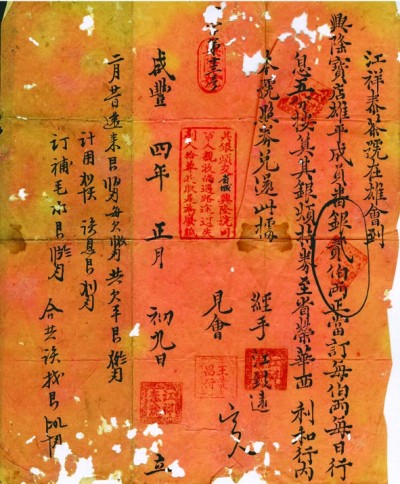
Meeting tickets of Huizhou tea merchants in 1854
According to the study of China’s economic history, in the late Qianlong period of the late 18th century, with the expansion of commodity trading volume, financial credit expanded rapidly. A concrete manifestation is that the private bank business has broken through the scope of simply exchanging money and money, and gradually developed into an institution for depositing money and credit and financing money with customers. As credit bills, money bills and meeting bills began to be exchanged and circulated in different regions, and they have the function of currency substitutes. Similar to Shanxi draft banks, Huizhou’s foreign exchange business is also extremely developed. More than 30 years ago, Weiqiao Township, Xiuning, Anhui Province, discovered 23 tickets collected by Hui merchants Xie’s family during the Kangxi period, which shows that as early as the late 17th century, it was quite common to handle exchange between Hui merchants. In addition, according to my research on the salt industry in Huaibei, in the late 18th century, there were also very frequent exchanges between Hankou and Yangzhou. All these show that some shops at that time had handled foreign exchange business, and commercial bills met each other’s financial and credit needs. Wang Maoyin is obviously very familiar with this kind of long-standing exchange business, and there are many related records in the letters quoted before Ji Yuexuan’s Letters. It can be seen that he and his family often use meeting tickets to engage in donation-related business and pay off their debts.
In fact, firms have always played a great role in many exchanges between Huizhou merchants in North China and the South. Until the early 20th century, the exchange between Hu Shi, a famous scholar in Beijing, and Jixi, his hometown, was often mediated by Hu Kaiwen Mozhuang. Therefore, people from Huizhou merchants’ families are often very familiar with this kind of operation. From this point of view, Wang Maoyin’s monetary proposition is obviously closely related to his family background and daily life.
From the actual function point of view, meeting tickets are vouchers cashed in different places, but some of them can be paid in circulation, which is equivalent to the role of banknotes. So in terms of nature, there is not much difference between the two in the traditional era.
During the Xianfeng period, there was a serious shortage of copper materials for coin casting in China, which led to an unprecedented "silver shortage" and "copper shortage". In order to get rid of the predicament, Qing officials have put forward various schemes one after another. In the first year of Xianfeng (1851), Wang Maoyin published "The Law of Banknote Discount". He first reviewed the history of coin issuance, and thought that in order to solve the financial difficulties, the great plan of the past dynasties was nothing more than casting big money or issuing banknotes. The advantages and disadvantages of the two are roughly the same, but the lesser of the two evils is more appropriate to issue banknotes. He suggested issuing silk banknotes funded by private banks, and the government was responsible for cashing them, so as to solve the financial difficulties at that time. Although this memorial was later refuted, from the ten suggestions put forward, Wang Maoyin had a very detailed overall consideration of the implementation of the banknote law, far exceeding the previous knowledge, which was obviously closely related to his rich commercial knowledge reserve. In the third year of Xianfeng (1853), Wang Maoyin became the right assistant minister of the household department and was in charge of the affairs of Qianfatang. Since then, he has put forward his own monetary proposition.
To sum up, the main points of Wang Maoyin’s monetary thought are as follows: First, to ensure the circulation and distribution of paper money, and to "use real money to transport virtual money", that is, to ensure the circulation of paper money with valuable metal money, and to enhance the credibility of paper money through the mutual exchange between paper money and metal money. Second, the circulation and issuance of paper money need to be controlled macroscopically, so as not to cause currency devaluation. Third, it is advocated that in the process of carrying out this reform, businessmen (especially financial businessmen engaged in the operation of banks and banks) should be used as intermediaries to issue paper money, and they should be paid a certain amount to arouse their enthusiasm. Among them, especially "using reality to transport emptiness" is the core of Wang Maoyin’s monetary thought. In view of the devaluation of the official bank notes issued at that time and the Qing dynasty treasure notes, he repeatedly stressed that the virtual and the real can be exchanged with each other, and only in this way can the credit degree of the notes be improved and the inflation be stopped from worsening. In fact, this proposition is no different from the common exchange of Xijia, a contemporary Huizhou merchant.
It is precisely because of this that Emperor Xianfeng decided that Wang Maoyin was "instructed by businessmen and did not care about the country". To this end, he was "strictly responsible, looking for the Ministry of War."

In 1853, the official ticket of the household department (see the anonymous series "Official Ticket for Xianfeng’s Travel", collected by the Institute of Humanities, Kyoto University, Japan)
According to the historical facts, Wang Maoyin had a close relationship with Huizhou merchants. Bao Kang, who is also a fellow countryman of Shexian County, has a comment on Wang Maoyin’s performance in his "Big Money Catalogue". Bao Kang blamed all the financial chaos at that time on Wang Maoyin, but he didn’t actually read the original text of Wang’s play, only heard that Wang Maoyin advocated allowing businessmen to exchange banknotes at hand. After this record, there is a note saying: In 1853, Shexian tea merchants paid taxes in Chongwenmen, Beijing with official tickets, but the tax authorities refused to accept them, which caused many businessmen’s doubts and panic, thus making the credibility of official tickets and precious banknotes lost and difficult to circulate everywhere. According to the imperial edict of Emperor Xianfeng, the so-called "directed by businessmen" may also be related to the tax payment incident of Chongwenmen of tea merchants. It is worth noting that in the above comments of "Big Money Catalogue", both official "treasure notes" and private tickets are mentioned. He said that at that time, because the government issued too many precious banknotes, the Beijing market was in a panic. Merchants all regarded the banknote law as a dangerous road. Most of the employees were banknotes and wanted to spend them as soon as possible, which caused many disputes. "with the national treasure of 1000 yuan, it is not worth the private ticket of 500 yuan." The private ticket mentioned here, of course, also includes the meeting ticket. Regarding private tickets among the people, Wang Maoyin once pointed out: "In the past, Tang and Song Zhifei’s money, jiaozi and Huizi were all shipped." The "virtual reality" mentioned here is also Wang Maoyin’s consistent view. However, most of the previous researchers were obsessed with the related issues of paper money, but did not pay more attention to the emerging exchange business during the Ming and Qing Dynasties.In fact, the core problem of Wang Maoyin’s monetary proposition-convertible paper money model, is similar to the booming conference ticket at that time.
tag
Xianfeng monetary system reform is a monetary reform under the new situation of unprecedented "money shortage", in which Wang Maoyin plays an important role. It is precisely because of this that his monetary thought is particularly eye-catching.
Wang Maoyin was born in a family of Huizhou merchants. Many of his ancestors, fathers, brothers and relatives did business in North China. His family’s exposure, long-term business practice and communication with relatives and friends prompted him to have a deeper understanding of China society. Under this background, he used the habitual thinking of commercial operation at that time, hoping to use the existing commercial network of the people and draw lessons from the emerging credit mode of commercial meeting tickets at that time, and put forward a solution to the currency crisis in the mid-19th century. It should be pointed out that at that time, not everyone realized the significance of exchange activities in social and economic development. Until the early 1960s, due to wartime traffic jams, the Qing government had no choice but to allow the exchange of Beijing salaries and association salaries to merchants, but there were still some bureaucrats who criticized and strongly opposed the practice of handing over the exchange to merchants, which happened many times. From this point of view, Wang Maoyin’s monetary proposition has certain foresight and important significance of the times. However, because the Qing government during the Taiping Heavenly Kingdom had exhausted its financial resources, the purpose of issuing paper money and large denomination coins was to fill the financial deficit and pass on the financial crisis to the people. In particular, it was impossible to establish the credit for issuing paper money and large denomination coins, which ran counter to Wang Maoyin’s claim, thus doomed his claim to be ignored and adopted.

Anhui Shexian county wangmaoyin former residence
[This article was originally published in Wenhui Scholar on September 9, 2016, entitled "Daily Life and Monetary Thought", which was the author’s speech at the "Chinese local history and beyond" conference held at the French Institute for Advanced Studies in Social Sciences (EHESS) on May 30, 2016. ]