The oldest plague in the world was finally defeated by this special China.
Original Tencent medical code
Leprosy, an ancient plague that has been talked about at all times and all over the world, makes patients disabled for life and becomes "ghosts and ghosts", which is extremely terrible.

(Lu Zhaolin. Source, Guiyang Evening News)
China is a famous leper, and Lu Zhaolin, a poet in the early Tang Dynasty, is one of them. He wrote the immortal poem, "Why should I resign from my life if I succeed? I would rather be a mandarin duck than a fairy." He also resigned from his post because of leprosy and isolated himself in Taibai Mountain.
How painful is it to get leprosy? Lu Zhaolin described his own misery in Five Sorrow and Poor Pass: "The bones are half dead, the blood is absolutely dead, the four branches are withered, and the five senses are missing …"
The general idea is that I am like a skeleton, half dead, my blood gas is very weak, my limbs are atrophied together, and my facial features are broken and distorted.
Lu Zhaolin once sought medical treatment from Sun Simiao, the king of medicine, but there was nothing he could do. He also hoped for the Taoist priest and ate a lot of "elixir" containing heavy metals, but his condition worsened. In the late stage, Lu Zhaolin was crippled by his hands and feet, and stayed in bed all day, eventually drowning himself in the Yinghe River.
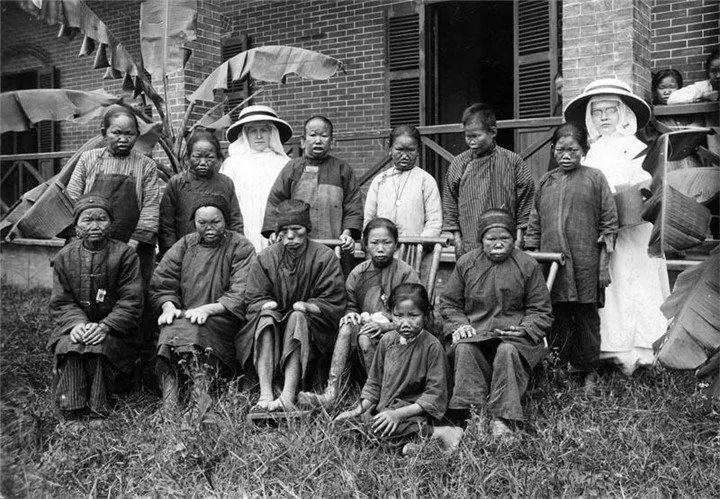
Leprosy patients and Canadian nuns in Guangdong Shilong asylum. Source, Forbidden City History Network)
In the early days of the founding of New China, leprosy was widely prevalent in various provinces in China, with about 500,000 patients, and Guangdong, Shandong, Jiangsu, Yunnan and other provinces were the hardest hit areas.
Now few people have heard of leprosy, and even many doctors don’t necessarily know what leprosy looks like.
How was leprosy eliminated? Can’t live without an old medicine and a person …

For a long time, there was no specific medicine for leprosy. Maple oil (the oil from the seed kernel of the plant Hyacinth) included in Puji Fang in Ming Dynasty is one of the few drugs that can treat leprosy in ancient times.
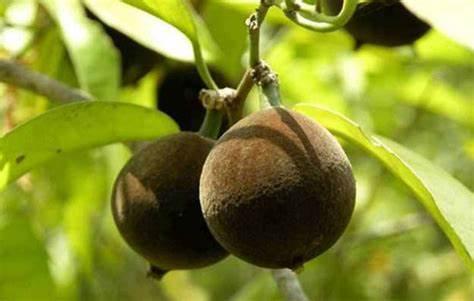
(The fruit of Hyacinthaceae. Source, network)
Until the late 1940s, doctors in Africa, Asia, South America and other places tried to inject patients with hyacinth oil. Although the treatment process was painful, some people’s conditions did improve.
With the development of chemical industry, in 1908, German chemists E. Fromm and J. Wei Teman first synthesized a compound called chlorobenzene sulfone (DDS). But it is just a trivial one among countless newly discovered compounds, and no one realizes its great medicinal value.

(dapsone tablets produced early in China. Source, network)
In the following 10 years, chlorobenzene sulfone was found to inhibit a variety of pathogenic microorganisms, such as streptococcus, mycobacterium tuberculosis, pneumococcus and leprosy. Unfortunately, it is too toxic to human body, so it can not be used in clinic for a long time.
Until 1941, Faget, an American, used the derivatives of chlorobenzene sulfone (similar to the brothers and sisters of the drug), rewriting the history of leprosy prevention and treatment in the world.
After repeated experiments, Faget chose a chlorpheniramine derivative named promin to do the experiment. After two years’ research, it proved that it had a good effect.
Because of the great side effects of injection, in 1947, doctors in Cochrane, England, tried to make dapsone into pills, which proved to be effective against leprosy, and had the advantages of low toxicity and simple oral administration.
Most importantly, dapsone is cheap and affordable for people in poor areas.
Since then, dapsone has become a life-saving drug for leprosy, and it has been widely used all over the world. Until 1970s, dapsone was internationally recognized as the first choice for leprosy treatment.
It is impossible to verify when dapsone entered China, but judging from the history of leprosy prevention and control in Zhejiang Province compiled by Zhejiang Dermatology Hospital [3], in the early 1950s, drugs such as dapsone, sulfanilamide, Dafengzi preparation and remifentanil were used to treat leprosy in Zhejiang Province.
By the early 1980s, more than 300,000 patients were cured with dapsone in China [4]. It can be said that this old medicine has made great contributions to the elimination of leprosy in China.

January 31st, 2021 is the 68th World Leprosy Prevention Day and the 34th China Leprosy Festival. We should cherish the memory of one person: Ma Haide.
Let’s turn the time back to the war-torn era.
In 1936, under the recommendation of Soong Ching Ling, 26-year-old American doctor George Heidem came to northern Shaanxi as a "well-trained western doctor" and became an advisor to the Ministry of Health of the Red Army. Meanwhile, he applied to join the Communist Party of China (CPC) and changed his name to Ma Haide. From then on, American young George became the "Doctor Ma" affectionately called by his comrades until the founding of New China.
In 1950, he helped to set up the Central Institute of Dermatology and Venereal Diseases.
At that time, there were about 500,000 leprosy patients in China, mainly distributed in Guangdong, Fujian, Jiangxi, Jiangsu, Shandong and other provinces. They are suffering from both physical and mental torture, and life is worse than death.
Because of the lack of medical treatment and social discrimination, if a leper is found in the village, the whole village will fall into panic.
In order to dispel everyone’s fear of leprosy. Ma Haide never wears a isolation gown or a white coat when he goes to a leprosy hospital, and he also shakes hands with patients to say hello.

(Ma Haide holds a leper’s hand tightly. Source: Dalian Evening News)
One Spring Festival, at Wangdu Leprosy Hospital in Hebei, Ma Haide took the initiative to shake hands with the patient, but one patient refused to reach out.
"Dr. Ma is shaking hands with you, but you are reaching out."
Hearing this, the old man shook his hand and burst into tears: "Since I got this disease for many years, no one dared to shake my hand. You are the first."
After Ma Haide’s long-term practice, people gradually eliminated their fear and prejudice against leprosy.
In 1976, Ma Haide was diagnosed with prostate cancer, but this did not affect his fight against leprosy! He traveled to hundreds of hospitals and prevention points all over the country, and even visited more than a dozen countries, winning medicines and medical devices worth tens of millions of dollars.
In 1980, he introduced a new foreign technology for the treatment of leprosy-the combined drug therapy (MDT) of rifampicin, chlorphenazine and dapsone to China, and promoted China to become the first country in the world to fully use the program [5].
In 1981, after a lot of research and investigation, he proposed to the Ministry of Health the goal of "basically eliminating leprosy in China in 2000".
In 1988, Ma Haide won the "Gandhi International Leprosy Award", and the Ministry of Health of China also awarded him the honorary title of "New China Health Pioneer".
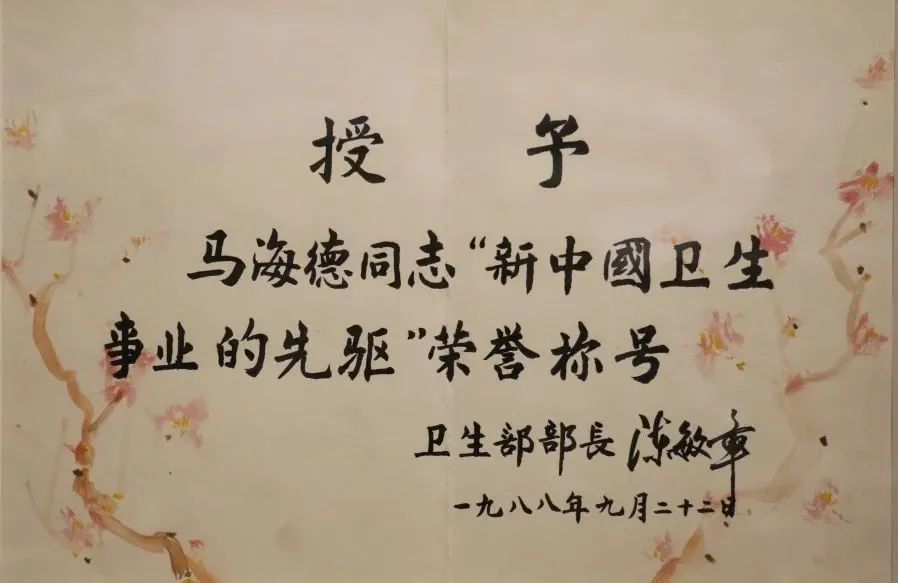
(The Ministry of Health awarded Ma Haide the honorary title certificate of "Pioneer of Health in New China". Source, China National Museum)
But at this point, his health is getting worse every day. Since the diagnosis of prostate cancer, he has undergone 8 major operations and lost more than 30 kilograms. But just a month before his death, he still wrote back to leprosy patients in his hospital bed.
On October 3rd, 1988, this China doctor from abroad left us.
From the time he set foot on China at the age of 23 to his death at the age of 78, Ma Haide devoted all his best years and even his life to China.
It is comforting to know that at that time, the number of leprosy patients in China dropped from more than 500,000 to less than 2,000, and the number of completely cured patients reached 210,000.

Leprosy is not a highly contagious disease. With the physical quality of modern people, more than 95% people have normal resistance to Leprosy, and even if they are infected with Leprosy, the incidence rate is very low [6]. However, in ancient and modern times, people often didn’t even have enough to eat, and their constitution was very weak and their immunity was very low. Naturally, there was no way to stop leprosy.
We know that there are three main ways to deal with infectious diseases:
The first is to control the source of infection. Find and control people or animals that can spread pathogens. The source of leprosy infection is mainly untreated multi-bacterial leprosy patients.
The second is to cut off the route of infection. For example, centralized isolation and home isolation are often used in epidemic prevention and control in COVID-19.
The third is to protect susceptible people. You don’t have to be afraid after vaccination.
In 1957, the Ministry of Health established the policy of "active prevention and control of infection" in the National Leprosy Prevention and Control Plan, and put forward the steps and practices of "investigation, isolation and treatment".
First of all, a large number of medical personnel are mobilized to go deep into the grassroots every year to carry out a general survey of leprosy, so as to achieve "early detection and early treatment". The census continued until the mid-1980s, and it was gradually terminated only after few new cases were found every year.
Secondly, hundreds of leprosy hospitals will be built in remote mountains and islands with inconvenient transportation and no water and electricity, and people will be treated on a large scale.
Finally, popularize dapsone and adopt newer combined drug therapy.
Compulsory isolation+dapsone monotherapy and other measures made it impossible to find many new cases of leprosy in the mid-1980s. In the case of low incidence, combined treatment can eliminate infectivity within a few months or even weeks, so that patients can return to society.
In 2000, the Ministry of Health of China announced to the world that the number of leprosy patients in China had dropped to about 2,000, and the prevalence rate was below 1 in 100,000, which basically eliminated leprosy.
Now, if leprosy patients are newly discovered, it is no longer necessary to isolate them.
The diagnosis and treatment of leprosy in China is free, and the course of treatment can be completed in half a year or one year, with good results. At present, there are less than 3,000 leprosy patients in China, and "realizing a world without leprosy" is becoming our dream within reach.
Reviewer: Xu Hongjun | Attending physician of dermatology, Beijing Friendship Hospital affiliated to Capital Medical University.
references
[1] The 19th International Leprosy Conference was held in Beijing. Xinhuanet. http://news.xinhuanet.com/politics/2016-09/19/c _ 129288305.htm.
Su Shixiong. Clinical application of dapsone in dermatology. Journal of Guangxi Medical College. 03, 1981.
[3] History of leprosy control in Zhejiang Province. https://mp.weixin.qq.com/s/qag3iiceis 6pk9lbc15ay
[4] courseware of 19th International Leprosy Conference. .http://www.chinalep.org/showNewsDetail.asp, China Leprosy Prevention and Control Association? nsId=79
[5] Report of the WHO Western Pacific Expert Group on Evaluation of MDT in China. china journal of leprosy and skin diseases. 01, 1981.
[6] the core knowledge of leprosy control and related questions and answers (2014 edition). http://www.chinacdc.cn/rdwd/201402/t20140206 _ 93246.htm.

Read the original text