Immersive drama "1927 Guangzhou Uprising" audience actors performed a red drama.
Guangzhou Daily All-Media Reporter Huang An
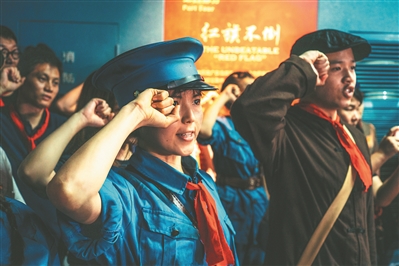
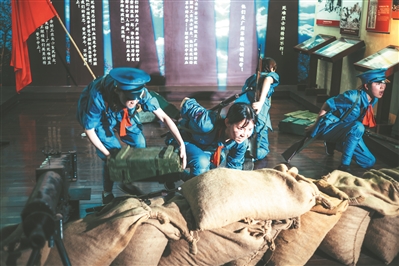
"This comrade, would you like to join me … …” As soon as the voice fell, the actor took the audience’s hand and walked into the museum, returning to the stormy Guangzhou Uprising in 1927 — — The 1927 Guangzhou Uprising, which is being performed in Guangzhou Uprising Memorial Hall, is an immersive drama created by Guangdong Revolutionary History Museum, which combines red culture education with art popularization. In just 45 minutes of performance, the audience shuttled with the actors in different areas of the museum, watching, feeling and experiencing the plot at zero distance. This innovative attempt made the memorial hall glow with new vitality and the number of receptionists surged.
"Zero distance" touches history, and the audience becomes part of the performance.
The Guangzhou Uprising in 1927 carried the banner of "Red Army of Workers and Peasants" for the first time in history, which set a precedent for urban-rural cooperation and armed uprising jointly held by workers, peasants and soldiers. The Soviet government in Guangzhou established in the uprising is known as "Paris Commune in the East".
Guangzhou Uprising in 1927 is an immersive drama created by Guangdong Revolutionary History Museum based on the history of Guangzhou Uprising. The whole drama is based on the place where the Guangzhou Uprising once took place — — Guangzhou Commune is the stage, and the audience is there, touching the grandeur and passion of history at zero distance.
In the first act of the performance, the Guangzhou uprising started. In the courtyard, characters such as "A Hui", "A Zheng", "Qiang Zi", "Hui Fang" and "Guo Hua" appeared one after another, calling on the audience to join their team. "Comrades, would you like to join me in the Guangzhou Uprising?" "I do!" The audience, already immersed in the historical situation, let go of their voices. Wearing the red cloth belt with the symbol of Guangzhou Uprising and taking the sickle and axe, the audience opened the door of history and started a dialogue with the revolutionary ancestors through time and space.
With the development of the plot, there are more and more interactions between actors and audiences, and the viewing scenes are constantly changing. Sometimes, in the Tianzi Wharf where bullets rained, I felt the fierce struggle between the female soldiers and the enemies several times as many as myself; Sometimes in front of the bright red party flag, I relive the solemnity of the pledge to join the Party. In order to rescue the revolutionary, the audience divided into two ways, and all the way followed the workers and peasants in the play to attack the fortress. All the people felt the tension of the great shift of the battlefield in the hurried footsteps. After hard fighting, the Soviet government in Guangzhou was finally established. Amid the cheers, the audience and the leading actor sang "The Internationale" passionately, and the passionate songs fluttered high above the memorial hall.
Walking out of the theater, the audience Ms. Su is still red-eyed. She told reporters that she was very moved: "I couldn’t help crying when I saw the scene of Huifang’s sacrifice. Without the sacrifice of revolutionary ancestors, there would be no happy life for us today." Xiao Wang, a post-90s generation, believes that replacing historical explanations with dramas is more vivid and lively, which makes young people closer to that period of history and realizes the revolutionary spirit of heroic ancestors who struggled hard and were not afraid of sacrifice.
Speaking of the creation of this drama, Wang Yuhan, the general director of the drama, said that unlike the artistic concept of "above life" in traditional drama, works with red themes must strictly follow historical facts, and nothing inaccurate or untrue is allowed. To this end, the crew visited historical experts and related units, constantly combing, and finally changed eight drafts before setting the script.
The bigger challenge is the design of the circuit. During the performance, the actors must lead the audience to shuttle up and down different exhibition halls. However, the space of the memorial hall is limited, and the beauty of music and dance is also limited. How to make the plot coherent under the constraints of the objective environment, and even a tree, a staircase and an exhibition hall can be used reasonably to serve the plot? In this regard, the crew went to the field for many times to explore and design, and finally solved the problems one by one.
The main creation comes from the local folk troupe, and the post-90 s young people are the main force.
Li Yuehui, the leading actor, recalled that there was a scene where he was standing by without his part. Suddenly an acquaintance came over and greeted him: "But I can’t jump out of the scene to talk to him. I have to be a role in the play. I can only pretend not to hear him and ignore him." "In the middle of another performance, a child suddenly hugged my thigh. He just liked your performance. At this time, I had to use the experience of the actor to improvise."
Li Yuehui, who has been engaged in drama for more than 20 years, believes that immersive drama breaks the "fourth wall" of traditional drama viewing mode in performance form and blends actors and audiences in one atmosphere. Facing the audience close at hand and within reach, this tests the actor’s sense of faith and professionalism.
Except Li Yuehui, most of the actors in the play are from Guangzhou folk professional drama performance groups — — Greek Troupe, which is dominated by young people, and 90% of them are professional actors who graduated from acting classes. Among them, Wang Fang, who plays "A Zheng", is a "post-90 s" who graduated from the Performance Department of Shenzhen University. In order to prepare for his role, he not only deeply understood the history of the Guangzhou Uprising, but also required himself to practice walking posture and eyes according to the standards of a soldier.
Wang Fang said that acting in this drama is actually a vivid patriotic education for himself. He recalled that in a performance, he once met an old audience: "I needed to salute the audience in the play. When I saluted him, the old man gave me a military salute in particular, and my tears stopped."
Speaking of this group of young people, the general director Wang Yuhan admits that he can feel their progress every day: "This performance requires the actors to have strong energy. At first, I was a little worried, but later I found that they were not bad at all. Some just graduated from college, and some came to apply for this troupe after working for several years, but they all had a passion for young people and their eyes were full of a desire to learn."
Wang Yuhan said that these post-90 s and post-95 s actors will have a certain distance from that period of history. In order to let the actors understand the choices of the young people in the play, the actors first conducted training and study for about three months, and went to Guangzhou Uprising Memorial Hall and Huangpu Military Academy to study before they started rehearsing. In order to cultivate the actor’s ability to deal with the crisis, Wang Yuhan chatted with the actor every day ten days before the premiere to simulate possible problems. These young people are very active in thinking and will propose a good solution: "The experience of these twenty performances is not only valuable experience for them, but also a win-win thing."
Activating history, the "red explosion" has received enthusiastic response.
Together with Nanchang Uprising and Autumn Harvest Uprising, Guangzhou Uprising became a great beginning for the Communist Party of China (CPC) to lead the revolutionary war independently and create the people’s army. Guangzhou Uprising represents the revolutionary spirit of the people of Guangzhou who dare to fight and be the first, and also reflects the important historical position of Guangzhou in the modern revolutionary history, which is an important part of Guangzhou’s history and culture.
As a story about the city and people of Guangzhou, The 1927 Guangzhou Uprising combines a lot of cultural elements of Guangfu. Participants can find familiar Guangzhou place names, classic songs, daily necessities and costumes with a sense of the times.
It is reported that "1927 Guangzhou Uprising" has received enthusiastic response since its premiere in July, and the drama schedule in July will expire as soon as it is announced. Due to the limited space, 40 people are expected for each game, but in the end, 70 or 80 people will come. There is an old man the same age as New China — — Mr. Kong, after knowing the performance, specially came from Huangshi Road to watch it. In addition, the Guangzhou Uprising Memorial Hall also launched a special session for disabled people, primary school students, retired military personnel and other groups. As of August 14th, there were 20 performances, 46 reception groups and 1668 audiences.
Chen Heyi, director of the mission department of Guangdong Revolutionary History Museum, said that the combination of red theme and immersive drama can be said to be the first in the country. At the end of each performance, volunteers will distribute questionnaires to the audience to collect their opinions and suggestions, and the museum will also hold meetings to discuss, exchange and constantly polish. Now this version has made great breakthroughs in all aspects, which can be said to be a leap from version 1.0 to version 3.0.
Participation Mode of Guangzhou Uprising in 1927
"1927 Guangzhou Uprising" was performed free of charge at the Guangzhou Uprising Memorial Hall. Interested audiences can pay attention to the performance schedule and make an appointment to participate through WeChat WeChat official account "Modern Guangzhou".