Thermal Interpretation | General Secretary of Mountain City Tour is concerned about this passage

The general secretary walked into the park and had in-depth talks with truck drivers, train employees and park managers in front of dense containers and China-Europe freight locomotives to understand the situation of accelerating the construction of new land and sea passages in the west.
In the hinterland of Chongqing, why is there such a "new land and sea passage"?
At one time, Chongqing, which was not near the sea or along the border, suffered from the lack of convenient and smooth foreign logistics channels, and its products were exported to the east via coastal areas or through high-priced air transport channels.
Seek according to the situation. In March 2011, China’s first China-Europe train line "Chongqing New Europe" was opened in Chongqing, shortening the time and space distance between the western inland and Europe from more than 40 days to about 12 days. Since then, Chongqing has joined hands with Guangxi, Guizhou, Gansu and other provinces to sign the framework agreement of "Southbound Passage", which has opened up a new channel for land and sea trade in inland areas.
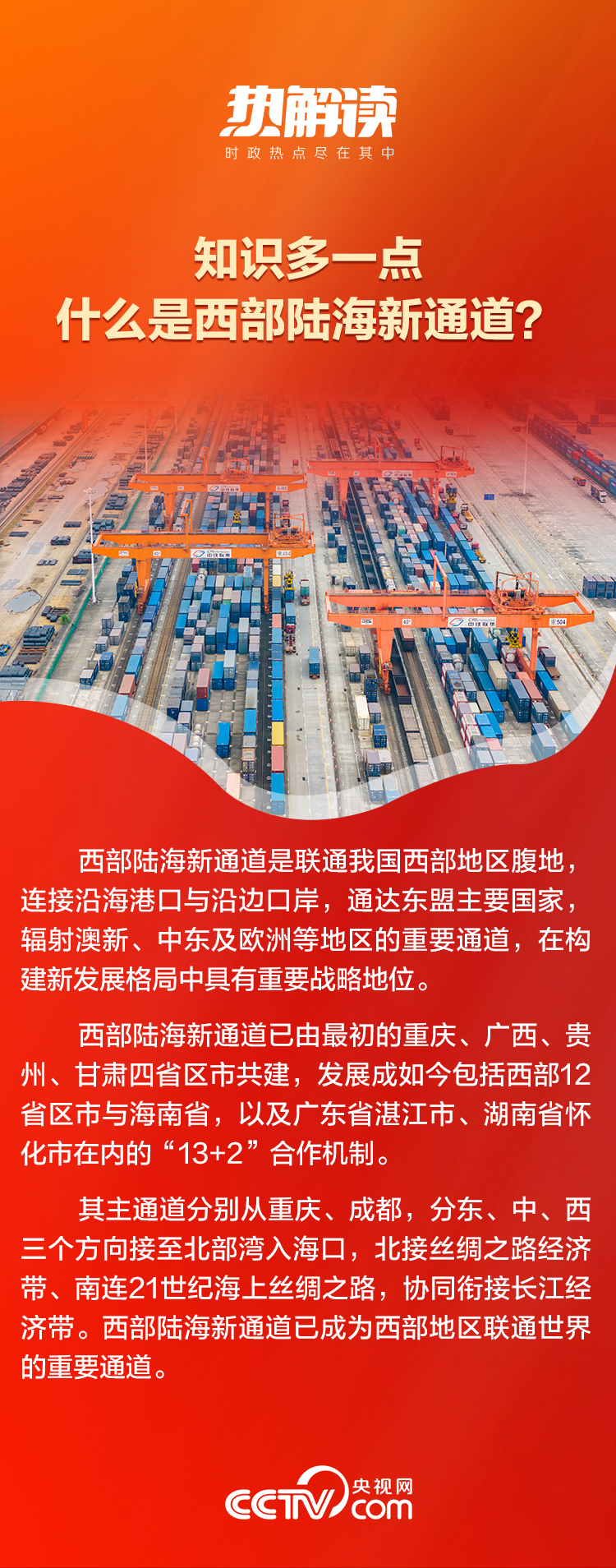
In September 2017, the new land and sea channel in the west was officially opened for operation. In August 2019, the National Development and Reform Commission issued the "Master Plan for the New Land and Sea Passage in the West", and the new land and sea passage in the west officially rose to the national strategy. In 2022, the Party’s Report to the 20th CPC National Congress clearly proposed "accelerating the construction of a new land and sea passage in the west".

The general secretary has always been very concerned about the construction of this passage. In recent years, when the General Secretary visited Guizhou, Shaanxi, Guangxi and other provinces and regions along the new land and sea corridor in the west, he repeatedly gave important instructions on the high-level construction of the new land and sea corridor in the west.
As an important national central city in China and the only municipality directly under the central government in the central and western regions, Chongqing plays a unique and decisive role in regional development and opening up.
With Chongqing as the operation center and the western provinces, autonomous regions and municipalities as the key nodes, the new land and sea passage in the west connects the Silk Road Economic Belt in the north and the 21st Century Maritime Silk Road in the south by means of railway, sea transportation and highway, and connects the Yangtze River Economic Belt in coordination, thus reversing the regional disadvantage of the inland areas in the west in opening up and laying an important strategic position for Chongqing.
The Chongqing International Logistics Hub Park visited by the General Secretary this time is the starting point of the China-Europe train (Chongqing New Europe) and the railway-sea intermodal train of the new land-sea passage in the west. It runs 62 international train lines in the four directions of east, west, north and south, which can radiate 503 ports in 112 countries, and the comprehensive operation index of China-Europe train (Chengdu-Chongqing line) has remained the first in the country for a long time.
Experts believe that the interconnection between China-Europe trains and the new land and sea passage in the west will effectively link up the "Belt and Road" externally and promote the opening up of the western region internally, which will help to further promote the construction of a new development pattern with the domestic macro-cycle as the main body and the domestic and international dual cycles promoting each other.
The new land and sea passage in the west is becoming a powerful engine to promote the high-quality construction of the "Belt and Road" in the western region.

Since its operation in 2017, the new land and sea passage in the west has changed from "one line" to "one network", from the initial cooperation between Chongqing and Guangxi to the new pattern of "13+2" provinces, autonomous regions and municipalities in China. Nowadays, the new land and sea passage in the west has developed from a logistics passage to a surging economic corridor, which has activated the "one pool of spring water" for industrial development along the line.
With the significant reduction of logistics costs, the once closed western region is releasing new vitality of open development relying on the new land and sea passage in the west.
Household appliances and new energy vehicles "made in the west" are continuously transported to foreign markets; Chongqing hot pot base, Guizhou Zunyi tea, Ningxia Lycium barbarum puree, Guangxi snail powder and other special foods have served as the dining table for the countries and regions jointly built by the Belt and Road Initiative. And Thai golden pillow durian can be put on the supermarket shelves in western cities within 10 days … …
Data show that as of March 29th, this year, 200,300 TEUs of container goods were transported by rail-sea intermodal trains in the new land-sea corridor in the west, up by 7.2% year-on-year. The new land and sea corridor in the west has become a veritable comprehensive international corridor, which is of great significance for strengthening economic and trade cooperation between China and countries along the route and maintaining the stability of the global supply chain.
"Accelerate the construction of new land and sea passages and the Silk Road in the air", "Build a new land and sea passage in the west at a high level", "Better serve and build a new land and sea passage in the west" and "actively dock the new land and sea passage in the west" & HELIP; …
All roads lead to prosperity. "Made in China" goes to the global market from here, and goods from all over the world enter thousands of households in China from here. It is the two-way mutual aid between the east and the west and the linkage between the land and the sea that gives the western region the infinite possibility of "embracing" the world.