When will the interest rate cut come? HSBC: At least these four conditions must be met.
After more than a year of aggressive interest rate hikes by the Federal Reserve, the European Central Bank and the Bank of England, inflation began to cool down. The market believed that the interest rate hike cycles of the three central banks had come to an end, and the suspension of interest rate hikes became the mainstream. It began to bet that the European, American and British central banks would start interest rate cuts one after another from April next year, but HSBC bluntly said that it was still too early to bet on interest rate cuts.
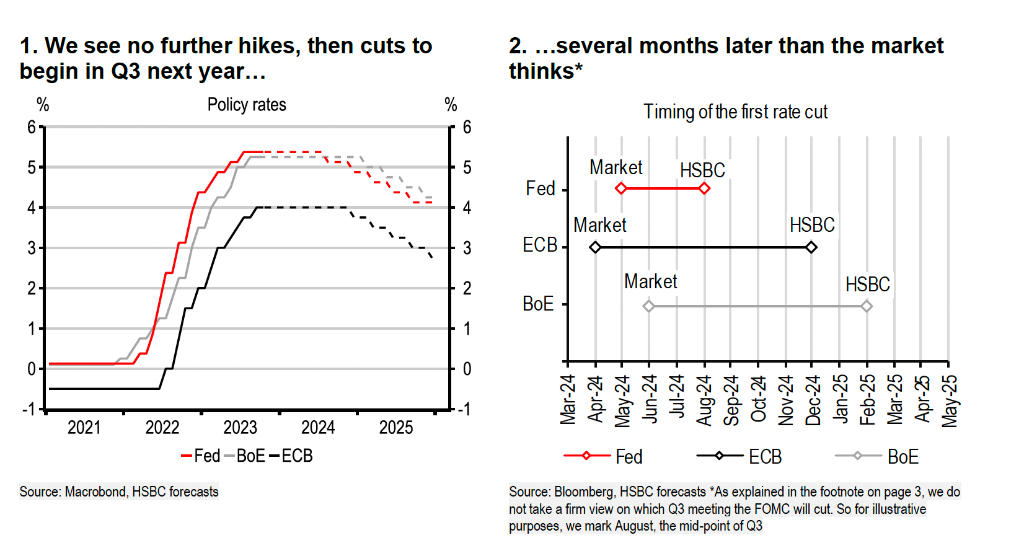
On November 20th, the team led by Chris Hare, a senior economist of HSBC analyst, pointed out in the report that the Federal Reserve, the European Central Bank and the Bank of England are not expected to raise interest rates further. From the time of interest rate cut,It is estimated that the Federal Reserve will cut interest rates in the third quarter of 2024, the European Central Bank will cut interest rates in the fourth quarter of 2024, and the Bank of England will cut interest rates in the first quarter of 2025..
HSBC bluntly said that the current market pricing for the Federal Reserve, the European Central Bank and the Bank of England to suspend interest rate hikes may be correct, but the pricing for interest rate cuts may be too dovish:
The market expects the Federal Reserve and the European Central Bank to cut interest rates twice before July next year and the Bank of England to cut interest rates twice before September next year. We think this expectation is too dovish.
In the context of global central banks’ extreme dependence on data, we believe that central banks want to see substantial signs pointing to deflation. By the middle of next year, they may not be able to see enough evidence.
So what kind of data does the central bank need to see before it chooses to cut interest rates?HSBC outlined four macro conditions.,In order of priority:
(i) GDP growth is lower than the long-term trend.; (ii) The unemployment rate has risen and exceeded the "equilibrium" level.(or there are signs of obvious cooling in the labor market, such as a decrease in the number of job vacancies); (iii) Wage growth rate dropped to 3.5%(HSBC believes that this is consistent with the inflation rate of 2%); (iv) The core inflation rate fell below 3%And the key point is that it is obviously in the trend of falling to 2%.
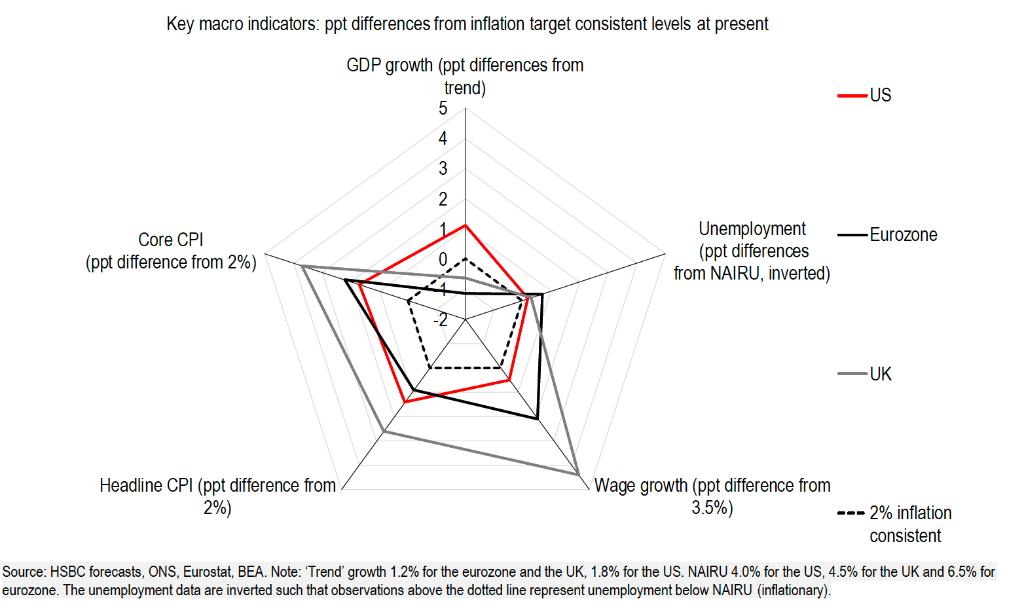
Therefore, the report pointed out that the current situation is that the core inflation in the United States in October was 4%, the core harmonized CPI in the Eurozone in October fell to 4.2% year-on-year, and the core inflation data in the UK was 5.7%, which is still a long way from meeting the above conditions. HSBC believes that,The United States is expected to meet the above conditions in the middle of next year, while Europe will be later because wages and inflation in Europe are more viscous.
At the same time, HSBC has also "left a retreat" for itself. The report said that even if their macro forecast is completely correct and the envisaged deflation gradually occurs slowly, it is difficult to know exactly when policymakers are ready to take action, and unexpected factors such as changes in real interest rates or salary agreements in the euro zone may upset the balance.
At the same time, HSBC also pointed out that the possibility of a major accident in inflation data cannot be ruled out, and such an "accident" will lead to their judgment running counter to the future situation:
Considering the recent guidance of the Federal Reserve, the European Central Bank and the Bank of England, when there is a major unexpected situation in the inflation data or the impact of the energy crisis again, this may trigger the central banks to raise interest rates further. If wages and inflation are more sticky than we judge, the interest rate cut may be postponed.
We believe that "dove risk" also exists: since we may not have seen all the effects of aggressive interest rate hikes in the past, central banks may have discovered the side effects of their excessive tightening of policies, so they need to start easing earlier.
Considering these risks, there will be some finely balanced policy decisions next year.
Theoretically, if the actual growth rate of GDP is lower than the potential growth rate, the growth rate of total demand will be lower than that of supply, and the output gap will appear, which may lead to deflation. But there are two complicated problems.
First of all, what is the potential growth rate?
HSBC pointed out in the report that in the United States, the Federal Reserve maintained its long-term economic growth forecast at 1.8%, while the potential growth rate in the euro zone and the United Kingdom was slightly higher than 1%.
Secondly, the supply growth may not be maintained at a fixed "trend" level (both demand and supply have experienced different degrees of decline during the epidemic, and supply is flexible according to the situation and may be affected by external factors).
Looking ahead, assuming that the economy is not facing a huge supply shock,Then the actual GDP growth rate below the potential growth rate will have idle capacity that can curb inflation.:
Therefore, although the GDP growth rate is lower than the potential growth rate is certainly not a sufficient condition for cutting interest rates, it may be a key part of the beginning of deflation.
In the report, HSBC pointed out that the persistent weakness of total demand is likely to eventually lead to a decrease in company recruitment, an increase in layoffs and an increase in unemployment rate. Phillips curve theory tells us that,Once the unemployment rate exceeds non-accelerating inflation rate of unemployment, it shows that the labor market may no longer be overheated, and it is expected that wage growth will eventually slow down and tend to be lower than the inflation rate of 2%..
Of course, HSBC said that NAIRU is not directly observed, but is usually estimated by observing the matching flow between jobs or the relationship between wages and unemployment rate. But for the interest rate outlook, what matters is what central banks think NAIRU’s data is:
In the United States, the Federal Reserve thinks NAIRU is 4%, while the Bank of England thinks NAIRU is 4.5% (in the monetary policy report in November this year, NAIRU was raised from 4.25% to 4.25%). The European Central Bank has not released its estimate, but its view may be not much different from the estimate of the European Commission, which is valued at 6.5%.
However, the report emphasizes that although the rising unemployment rate may be one of the backgrounds of interest rate cuts, it is not a necessary condition. If the unemployment rate remains stable or even gradually decreases; then central banks may need of wait for other signs for easing of the labor market of support the cooling for the labor market; such as the reduction for job vacancies:
Of course, this form of labor market cooling rather than rising unemployment rate will be an ideal situation, and this situation is actually the market’s judgment on the recent cooling of the labor market in the United States.
If the cooling of the labor market begins to lead to a decline in wage growth, then the next key question is,What kind of wage growth rate can match the inflation rate of 2%?
HSBC thinks this "magic number" is about 3.5%. The reason for this is the following:
First of all, for the company’s cost, what really matters is the unit labor cost (ULC)– the cost of production unit output. And the increase of unit labor costMainly the difference between wage growth and productivity growth.Assuming that the "trend" productivity increases by 1% every year,3.5% wage increase means 2.5% unit labor cost increase, which is very important.Because labor costs account for about two-thirds of the company’s costs.
Assuming that other costs will not increase by more than 2% and the company’s profit rate will be stable in the long run, inflation will be highly consistent with the growth rate of ULC.
As an indicator that lags behind the past development of labor demand and the past inflation results at least in theory, we believe that wage growth does not need to be lower than 3.5% to trigger interest rate cuts, but it may not be higher than 4%, and it is best to be in a downward trend.
HSBC believes that, like wages, the core inflation rate will slowly decline. Therefore, the core inflation rate does not need to be as low as 2% to trigger a rate cut.The core inflation rate is below 3% and is on the downward channel, which may be enough for central banks to start the interest rate cut cycle.
Why 3%?
HSBC pointed out that although the figure of 3% is only their own judgment, both the Bank of England and the Federal Reserve have evidence that this figure is crucial:
For the Bank of England, when the inflation rate exceeds 1 percentage point of the target of 2% (that is, more than 3%), the governor of the central bank needs to write an open letter to the Chancellor of the Exchequer to explain the reasons. Therefore, more than 3% is an inflation rate that attracts the attention of the central bank.
For the Fed, the bitmap shows that the core inflation rate is expected to be 2.5%-2.8% in 2024, and this is the time when the interest rate cut begins.
HSBC pointed out that the above four conditions are so simple in theory, but what is the actual situation? Judging from the current situation of key variables,Central banks still have a long way to go, especially in Europe, especially in Britain, where wage growth is still too fast.
Judging from the situation in Europe, the labor market is still tense even though the GDP growth rate is almost not positive (the unemployment rate in the euro zone is 6.5%, while that in the UK is 4.2%, which is equal to or lower than the official NAIRU).
Most importantly, the wage growth rate is still too fast. The average wage growth rate in the euro zone in the second quarter was 5.6%, while the average weekly wage growth rate in the UK in September was 7.9% year-on-year, which is still far from the critical value of 3.5% set by us. Therefore, it is not surprising that the core inflation rate in the euro zone and the UK increased by 4.2% and 5.7% respectively in October, which is still at a disturbingly high level.
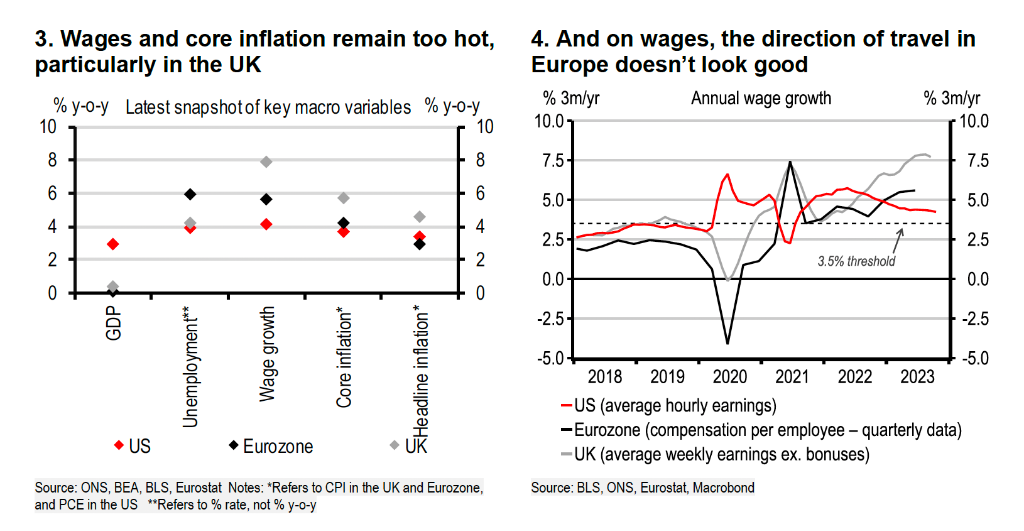
HSBC pointed out that in the United States, these key indicators do look better, but they still show greater cost and price pressure:
Core inflation in the United States dropped to 4% in October, which is more optimistic than inflation in the euro zone and Britain, but it is still a high inflation rate. Enterprises also said that the overall situation of the labor market is still tense. In addition, the economic growth of the United States is unexpectedly strong, and the growth in the third quarter of this year is much higher than the trend. This trend of strong demand may further put upward pressure on costs and prices.